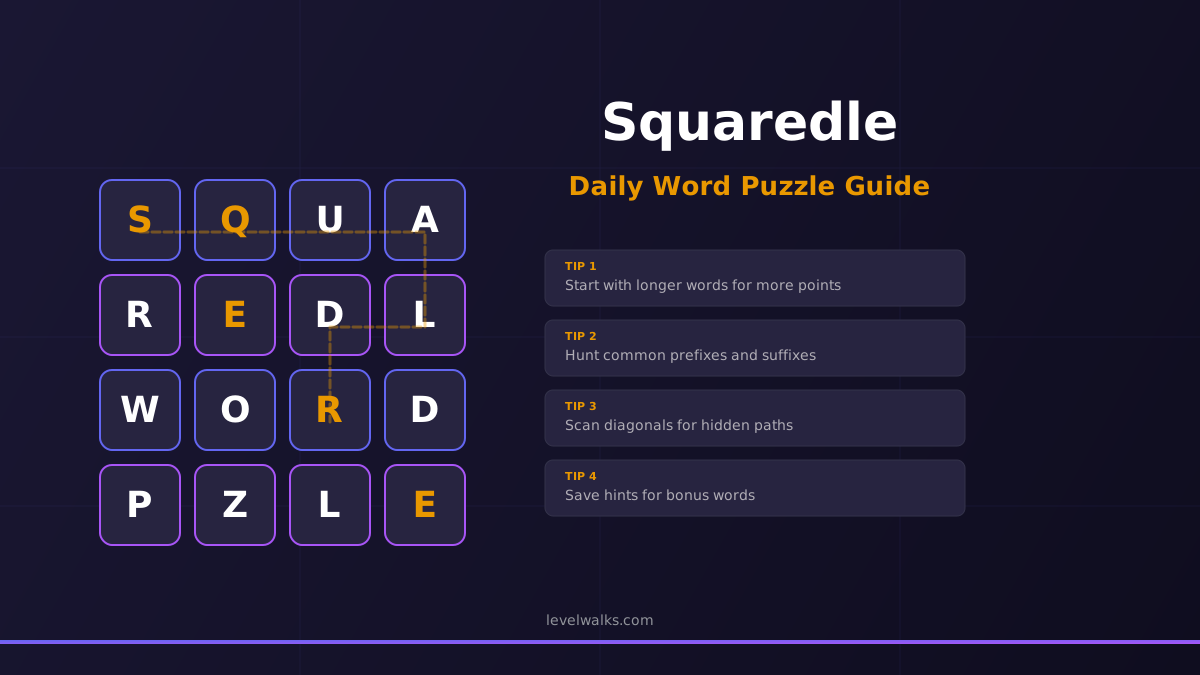
Squaredle is a daily word puzzle where you trace paths through a 4x4 letter grid to find hidden words. Letters must be adjacent (including diagonals), and each cell can only be used once per word. Start by mapping vowels and rare consonants (Q, Z, X, J), build outward from common prefixes, and aim for longer words first since they often reveal shorter ones along the way. The daily puzzle resets at midnight and typically contains 40-80+ valid words, including bonus words beyond the required list. This guide covers the mechanics, practical solving strategies, bonus word hunting, and how Squaredle stacks up against Wordle and NYT Connections.
What Is Squaredle?
Squaredle is a free daily word puzzle created by independent developer Andy Hall. The concept: you get a grid of letters — usually 4x4, sometimes larger for weekend puzzles. And need to find as many valid English words as possible by tracing connected paths through adjacent cells. Think of it as Boggle meets a daily challenge format. One new puzzle per day, everyone gets the same grid, and the goal is to uncover every word the puzzle contains.
Unlike Wordle, which gives you six guesses to nail one five-letter word, Squaredle asks you to exhaustively search a grid. A typical daily puzzle contains somewhere between 40 and 80+ valid words, ranging from straightforward four-letter entries to obscure eight- or nine-letter finds. The puzzle tracks which words you've found and which remain hidden, and it separately marks "bonus words" that exist in the grid but aren't required to complete the puzzle.
Finding every single word, bonus ones included, is genuinely difficult. Most players settle for clearing the required list and calling it a win. The game is available on the web at squaredle.app, plus iOS and Android, all free for the daily puzzles.
How the Grid Works
The rules are simple, but the implications run deep:
- Adjacency: Each letter in your word must be horizontally, vertically, or diagonally adjacent to the previous letter. You trace a connected path through the grid. All eight directions count.
- No reuse: A single cell cannot appear twice in the same word. If the grid has only one "E," you can't spell a word that needs two E's.
- Minimum length: Words must be at least four letters long. Three-letter words are rejected regardless of whether they're real English words.
- Dictionary: Squaredle uses a curated word list. Proper nouns, abbreviations, and extremely obscure terms are excluded. Occasionally a word you're confident about gets rejected. Frustrating but consistent across all players.
Grid position matters more than you'd expect. A letter in the center of a 4x4 grid has eight neighbors, meaning it can connect to eight different next-letters. A corner letter has only three neighbors. This means center letters are far more versatile for word-building, and words that route through the middle of the grid are statistically more common than words that hug the edges.
Weekend puzzles sometimes expand to 5x5 or larger. A 5x5 grid has 25 tiles and a much bigger pool of possible paths. This sounds like it should make finding words easier, but the larger surface area makes systematic scanning harder and bonus words get considerably more obscure.
Basic Strategies for Finding Words
1. Map the Vowels First
Before you start tracing words, spend 10 seconds noting where the vowels sit. Every English word needs at least one vowel (with rare exceptions like HYMN or MYTH), so vowel positions define your word-building corridors. If A, E, and I cluster in one quadrant, that's where most of your words will route through. If the vowels are spread evenly, you have more options but also more ground to cover.
A practical trick: for each vowel, look at its immediate consonant neighbors. TH next to an E? You probably have THE- words (THEM, THEN, THESE). An O next to N and T? Check for TONE, NOTE, TONIC. Vowel-consonant pairs are your building blocks.
2. Hunt for Rare Letters
If the grid contains Q, Z, X, J, or K, those letters narrow your search space in a helpful way. Q almost always needs a neighboring U (QUIZ, QUAD, QUEEN). Z pairs with common endings like -ZE or -ZEN. X appears in EX- prefixes or -AX/-OX endings. Because these letters have so few valid combinations, spotting them first often hands you two or three words immediately with minimal effort.
3. Start Long, Then Go Short
This feels counterintuitive. Wouldn't shorter words be easier to find? They are, but here's the thing: a seven-letter word contains multiple shorter words as substrings. If you find CASTING, you've also likely spotted CAST, STING, and possibly GIST along related paths. Working from long words down means you naturally uncover shorter ones as byproducts, whereas starting with short words gives you no help finding longer ones.
Scan the grid for common long-word patterns first: -ING endings, -TION suffixes, RE- or UN- prefixes. If you spot an I-N-G sequence where each letter neighbors the next, trace backward from the G to see what words end there.
4. Work Outward From Common Prefixes
English has a small set of common prefixes that appear constantly: RE-, UN-, PRE-, OVER-, OUT-, DIS-. If you spot any of these letter sequences adjacent in the grid, treat them as anchor points. From RE-, trace every possible continuation: REAL, READ, REIN, RENT, REST. From UN-, check for UNDO, UNIT, UNDER. Prefix hunting takes about two minutes at the start of each puzzle and consistently adds five to ten words to your count.
5. Check for -ED, -ER, -LY, and -ES Variants
Found TURN? Immediately check whether TURNS, TURNED, or TURNER are traceable. Found SLOW? Look for SLOWED, SLOWER, SLOWLY. These suffixed forms are separate valid words in Squaredle's dictionary, and they're often adjacent because the base word already routes near S, E, D, R, and Y cells. This single habit reliably adds 8-12 extra words per puzzle with minimal extra scanning.
Advanced Techniques
Pattern Recognition Across Puzzles
After a few weeks of daily play, you start recognizing letter arrangements that reliably produce specific words. An E-R pair almost guarantees -ER endings (MAKER, TIMER, LATER). An S adjacent to T means -ST endings are available (FAST, MIST, COST). These pattern shortcuts become automatic over time, and they let experienced players find 20-30 words in the first two minutes while newer players are still scanning cell by cell.
Keep a mental catalog of productive two-letter pairs. TH produces THE, THAT, THEM, THIS, THING. ST produces STAR, STEM, STONE, STING, STAIN. This is vocabulary knowledge applied spatially, and it sharpens with every puzzle you complete. Research on word puzzle games and brain training suggests that this kind of pattern drilling improves fluid reasoning over time, not just puzzle performance, but general cognitive flexibility.
The Diagonal Advantage
New players tend to trace words in straight lines. Horizontal or vertical. But diagonal connections are where the interesting words hide. A letter has four diagonal neighbors in addition to its four cardinal neighbors, and diagonal paths let you jump across the grid in ways that horizontal/vertical movement can't. When you're stuck and the obvious words are exhausted, deliberately trace diagonal zigzag paths. You'll find words that seem invisible when you only look at rows and columns.
Reverse Engineering From Hints
Squaredle's hint system reveals where a word begins in the grid without spelling it out. If you know there's an unfound six-letter word starting with C, you can narrow your search dramatically: find every C in the grid, then trace all possible six-letter paths starting from each C. On a 4x4 grid, the number of valid six-letter paths from any single cell is actually manageable, usually under 20 possibilities. Mentally running through them takes about 30 seconds and almost always surfaces the missing word.
Suffixes as Finishing Moves
Once you find a base word, immediately check whether common suffixes are available in adjacent cells. Found PLAY? Check for PLAYS, PLAYED, PLAYER, PLAYING. Found TURN? Look for TURNS, TURNED, TURNING. English is heavily suffix-driven, and a single base word can yield three or four variants if the right letters neighbor the word's endpoint. This one habit can increase your word count by 30-40% per puzzle.
Letter Frequency Analysis
Not all grid positions are equal. In English, the letters E, T, A, O, I, N, S, and R appear most frequently in words. When your grid contains multiple high-frequency letters clustered together, that cluster is almost certainly a word factory. Trace every possible path through it. Conversely, if two low-frequency letters like V and W sit next to each other with no vowel nearby, don't waste time trying to force words through that area. Directing your attention toward the high-frequency clusters and away from the dead zones is what separates a 15-minute solve from a 30-minute one.
The Daily Challenge and Bonus Words
The daily Squaredle puzzle resets at midnight. Everyone worldwide gets the same grid, which creates a shared experience, you can discuss the puzzle with friends without worrying about different boards. Two puzzles are available each day: the main puzzle accessible immediately, and a second one that unlocks after completing the first.
The required word list typically runs 20 to 40 words on weekdays. Beyond that, there are bonus words. Valid words in the grid that aren't required for completion. The game tracks them separately, and many regular players treat bonus words as the real challenge. Some daily grids contain over 100 bonus words, far more than the required ones. Hunting bonus words is where a deep vocabulary pays off, since they often include less common English words like TERCE, SPEAN, or NIEVE that casual players wouldn't think to try.
Squaredle also runs an Express puzzle. A smaller, quicker grid meant to be solved in under five minutes. It's a solid warm-up before tackling the main grid, and it helps calibrate your brain for the spatial pattern-matching the full puzzle demands.
One honest downside worth naming: mid-week puzzles sometimes include genuinely obscure required words. When a word you've never encountered is blocking your completion and the hint system only tells you where it starts, the experience can feel more frustrating than challenging. That's a real limitation of the format. If you enjoy puzzle games that test lateral thinking, you'll likely have the patience for these moments. If not, the Express puzzle might be more your speed.
Squaredle vs Wordle vs NYT Connections vs Spelling Bee
| Feature | Squaredle | Wordle | NYT Connections | Spelling Bee |
|---|---|---|---|---|
| Objective | Find all hidden words in a letter grid | Guess one 5-letter word in 6 tries | Group 16 words into 4 categories | Make words using 7 letters (center required) |
| Time to Complete | 10-30 minutes | 2-5 minutes | 5-10 minutes | 15-45 minutes |
| Skill Type | Vocabulary + spatial reasoning | Deduction + letter frequency | Lateral thinking + categorization | Vocabulary breadth |
| Guess Limit | Unlimited | 6 guesses | 4 mistakes | Unlimited |
| Spatial Element | Yes (grid adjacency) | No | No | No |
| Replay Value | High (bonus words extend play) | Low (one puzzle per day) | Low (one puzzle per day) | Medium (Genius rank chase) |
| Vocabulary Benefit | Strong. Exposes obscure words regularly | Moderate | Moderate, tests word associations | Strong. Rewards rare words |
Squaredle scratches a different itch than Wordle. Wordle is a sprint — quick, binary, satisfying when you nail it in three guesses. Squaredle is more of a slow exploration. You keep finding words, keep getting that small dopamine hit with each discovery, and the session naturally stretches longer. If Wordle leaves you wanting more after two minutes, Squaredle fills that gap.
The spatial element is what makes Squaredle unique in this group. Spelling Bee and Wordle are pure vocabulary/deduction games with no positional constraint. Connections tests pattern recognition. Only Squaredle requires you to think about where letters physically sit relative to each other, which engages a different part of your problem-solving toolkit.
Common Mistakes to Avoid
Only Searching Horizontally and Vertically
The single biggest mistake new Squaredle players make. Diagonal connections are just as valid as horizontal and vertical ones, and roughly half of all valid words in any given grid require at least one diagonal step. If you're only tracing straight lines, you're missing half the puzzle.
Giving Up on a Word Too Early
You think of STRANGE, scan the grid, don't immediately see the path, and move on. But there might be a valid path you missed because the R-to-A connection was diagonal, not horizontal. Before dismissing a word, trace every possible starting point for its first letter and check all eight directions for the second letter. Many "impossible" words turn out to be perfectly traceable once you consider diagonal routes.
Forgetting About Less Common Words
Squaredle's word list includes plenty of words you might not use in conversation: DOIT, NAIRU, GLOAM, TAHR, SPAE. If you only search for words you'd use in a text message, you'll miss 20-30% of the required list and most of the bonus words. There's no penalty for wrong guesses in Squaredle, so just try words you're not 100% sure about. The game tells you if they're valid.
Burning Hints on Easy Words
The hint system is limited. Using a hint on a word you could have found with another 30 seconds of scanning means that hint won't be available later when you're genuinely stuck on an obscure required word. Save hints for the final 2-3 words of the required list. Those are almost always the hardest and most likely to need the nudge.
Staying Safe While Gaming Online
Quick note on something tangentially related but worth mentioning: if you play Squaredle or other browser-based word games on public Wi-Fi (coffee shops, airports, libraries), your traffic is potentially visible to others on the same network. This matters less for a word puzzle than for logging into your email, but gaming sessions often happen alongside banking, social media, and other sensitive browsing.
A VPN encrypts your connection so anyone snooping on the same public network sees nothing useful. NordVPN is one of the more reliable options, fast enough that you won't notice any lag during browser-based games, and it covers all your other browsing too. Not strictly a Squaredle tip, but worth having if you puzzle on the go.
Frequently Asked Questions
How many words does a typical Squaredle daily puzzle contain?
The required word list usually ranges from 20 to 40 words on weekdays, scaling up to 40-60 for larger weekend grids. Including bonus words, the total can exceed 150 on grids with common letters like E, S, T, R, and A. Grids loaded with uncommon letters (Z, Q, X) tend to have fewer total words but harder individual finds.
Is Squaredle free to play?
Yes. The daily puzzles are completely free on the web, iOS, and Android. An optional paid tier unlocks features like statistics tracking, an ad-free experience, and access to archived puzzles. The core daily gameplay costs nothing, and most players never need the premium features.
Can the same letter cell be used in multiple different words?
Yes. The restriction is that a cell can only be used once within a single word. Across different words, every cell is reusable. The same E in the center might appear in STEM, LEMON, TAKE, and VERSE as part of separate words. This is why center cells are so valuable. They participate in far more words than edge or corner cells.
Is Squaredle harder than Wordle?
They test different skills, so "harder" depends on your strengths. Wordle is tougher if you struggle with deductive logic under a guess limit. Squaredle is tougher if your vocabulary is limited or spatial path-tracing doesn't come naturally. Most players who enjoy both say Squaredle takes significantly more time per session (15-25 minutes vs 2-3 minutes) and rewards a larger vocabulary, while Wordle rewards strategic elimination. Neither is objectively harder. They just tax different parts of your brain.
Can you play past Squaredle puzzles?
The web version at squaredle.app maintains an archive of past puzzles you can access after completing the current day's puzzle. This is a genuine advantage over Wordle and Connections, which offer no free archive. If you miss a day or want to practice on older grids, earlier-week puzzles are good for building systematic scanning habits before tackling harder days.
What is the minimum word length in Squaredle?
Four letters. Any valid English word with four or more letters that can be traced through adjacent cells counts. Three-letter words are always rejected, even common ones like THE or AND. This minimum length rule filters out the hundreds of trivial short words that would make every puzzle feel identical.
How do bonus words work in Squaredle?
Bonus words are valid traceable words that exist in the grid but aren't part of the required list. Finding them earns you additional credit and contributes to your daily score, but you don't need them to "complete" the puzzle. The bonus word count varies from around 30 to well over 100 depending on the grid's letter composition. Dedicated players treat clearing all bonus words as the real victory condition.