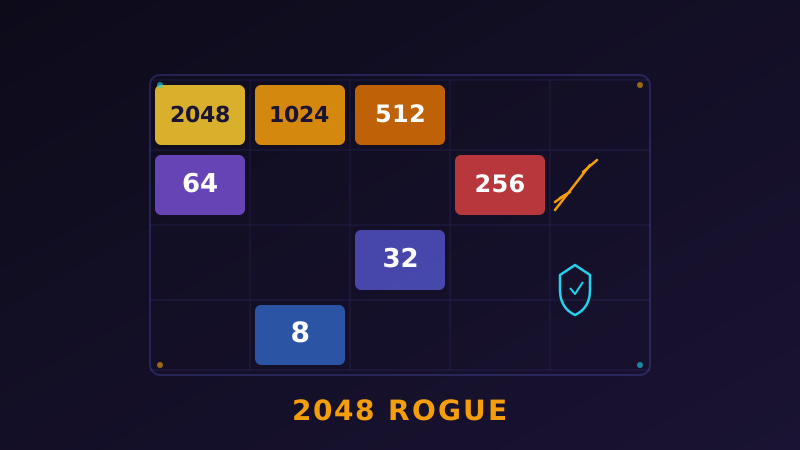
2048 Rogue is a roguelike twist on the classic 2048 tile-merging formula. Instead of one endless board, you progress through floors with randomized modifiers, collect power-ups between runs, and face obstacles that force you to adapt your merging strategy on the fly. The corner strategy still works as your foundation, but power-up selection and chain merging matter far more here than in vanilla 2048. Keep your highest tile anchored in one corner, build descending chains along edges, save your shield power-up for floors with tile-locking modifiers, and always pick the multiplier upgrade over extra moves when offered. This guide breaks down every mechanic, compares 2048 variants side by side, and gives you a floor-by-floor strategy for pushing deep into the later stages.
What Is 2048 Rogue?
Take the 4x4 tile-merging grid from the original 2048, then layer on roguelike progression: floors you ascend through, randomized modifiers that alter the rules each floor, power-ups you choose between runs, and a meta-progression system that carries permanent upgrades across attempts. That's 2048 Rogue in a sentence.
The original 2048 — created by Gabriele Cirulli in 2014. Is a single continuous game. You swipe, tiles merge, and eventually the board fills up or you hit the 2048 tile. 2048 Rogue restructures that into discrete "floors" of roughly 20-40 moves each. Clear the floor's target tile (say, 256 on floor 1, 512 on floor 2) and you advance. Between floors, you pick one of three randomly offered power-ups. Die on any floor and your run ends, but some upgrades persist.
What makes it stick is the tension between short-term board management and long-term build planning. In classic 2048, you have one strategy: survive. In 2048 Rogue, you're also asking "which power-up sets me up for floor 7?" while managing a board that has a frozen tile in the corner because floor 4's modifier locked it there.
How Roguelike Mechanics Change the Game
If you already know vanilla 2048, the roguelike layer changes three things fundamentally:
1. Runs Are Finite, Not Endless
Each floor has a target tile and a move limit. You don't have infinite swipes to slowly build your way up. This creates urgency that classic 2048 lacks. Sometimes you need to abandon a perfect corner setup and just merge aggressively to hit the target before your moves run out. The pacing feels completely different. Floors 1-3 are relaxed. Floor 5+ starts punishing hesitation.
2. Power-Ups Create Build Diversity
After each floor, you choose from three power-ups: things like "merge any two adjacent tiles regardless of value," "add 5 extra moves to the next floor," or "start the next floor with one tile already at 64." The choices you make compound. Two runs with the same player skill can look completely different depending on which power-ups appeared and which ones were selected. This is where the roguelike DNA shows most clearly.
3. Floor Modifiers Force Adaptation
Each floor can have a modifier: locked tiles that can't be moved, bomb tiles that destroy adjacent tiles when merged, walls that block one direction of movement, or multiplier tiles that double the value of whatever merges into them. You won't know the modifier until the floor starts. The reliable corner-and-edge strategy from classic 2048 still works as a foundation, but modifiers force you to improvise on top of it.
Corner Strategy: Still King
The corner strategy from classic 2048 carries over directly: keep your highest-value tile locked into one corner of the grid. Most experienced players pick the bottom-left or bottom-right corner and never move their anchor tile away from it. In 2048 Rogue, this remains the single most reliable way to maintain board control across every floor.
Here's how it works in practice. Say you anchor bottom-left. You primarily swipe down and left. Those two directions push tiles toward your anchor corner. You swipe right only when you need to merge tiles along the bottom row. You swipe up as rarely as humanly possible, because every upward swipe risks pulling your anchor tile away from the corner, and once that happens on a crowded board, recovery is often impossible.
The 2048 Rogue twist: floor modifiers can disrupt your corner. A "wall" modifier might block leftward movement entirely, making a left-corner anchor useless for that floor. When this happens, the experienced move is to temporarily pivot your anchor to a different corner rather than fighting the modifier. Spend your first 3-4 moves on a new floor reading the modifier before committing to a corner.
Edge Building and Chain Merging
Once your anchor tile is locked in a corner, the next technique is edge building: arranging tiles in descending order along the edges of the grid. Your bottom row might read 512-256-128-64 from left to right, with your anchor 512 in the corner. The left column might read 512-32-16-8 from bottom to top. This creates a snake-like chain where a single merge can cascade through multiple tiles.
The Chain Merge
A chain merge happens when merging two tiles creates a new tile that immediately has a merge partner next to it. Example: you have 64-64-128 in a row. Merge the two 64s into 128, and now you have 128-128, which merges into 256. Two merges from one swipe. In 2048 Rogue, chain merges are critical because of the move limit. Every move that triggers a chain is essentially a free extra move.
Setting up chains requires keeping your edge tiles in strict descending order with pairs ready to cascade. The ideal setup before a big merge: 256-128-128-64 along the bottom. One rightward swipe merges the 128s into 256, the two 256s merge into 512, and you've jumped three tile levels in a single move. On floors with tight move limits, these chains are the difference between clearing and dying.
When to Break the Chain
Sometimes the board forces you to place a tile that breaks your descending order, a 4 appears between your 128 and 64, ruining the chain. In classic 2048, you'd patiently work around it. In 2048 Rogue, the move limit means you might need to accept the broken chain and build a parallel chain on the adjacent edge instead. Two imperfect chains can outperform one perfect chain when time is short.
Power-Ups Ranked by Value
Not all power-ups are equal. After about 40+ runs, here's how they stack up in terms of impact on deep runs:
| Power-Up | Effect | Tier | When to Pick |
|---|---|---|---|
| Score Multiplier (x2) | Doubles merge points for one floor | S-tier | Always, especially floors 5+ |
| Shield | Blocks one floor modifier entirely | S-tier | Save for tile-lock or wall floors |
| Wild Merge | Merge any two adjacent tiles once | A-tier | When board is near-deadlock |
| Head Start (64 tile) | Begin next floor with a 64 placed | A-tier | Floors 3-5 where targets jump |
| Extra Moves (+5) | 5 additional swipes next floor | B-tier | Only if S/A tiers unavailable |
| Tile Bomb | Remove one tile from the board | B-tier | When a misplaced tile blocks chain |
| Undo (+1) | Revert the last swipe | C-tier | Rarely worth the slot |
The multiplier is almost always the correct pick. The math is straightforward: doubling your merge points on a floor where you're making 15-20 merges outweighs 5 extra moves that might not even be needed. The shield is the other must-pick, but it's situational. Save it for when you know a hard modifier is coming (floors 6 and 8 typically have the nastiest ones).
Undo sits at C-tier because it only saves you from one mistake, and in a roguelike where adaptation matters more than perfection, one extra undo rarely changes a run's outcome. You're better off learning to read the board faster than relying on a safety net.
Floor Modifiers and How to Handle Them
Locked Tiles
One or two tiles on the board are frozen in place, they can't be moved by swiping. You can still merge into them (if an adjacent matching tile slides into them), but the locked tile itself stays put. The counter-strategy: treat locked tiles as permanent obstacles and build your edge chains around them. If a locked tile sits in your anchor corner, switch corners immediately. Don't waste 5 moves trying to work around a locked anchor. The move limit won't forgive it.
Directional Walls
One swipe direction is disabled for the entire floor. "No up swipes" is the most common. This forces you to rethink your corner choice and edge-building direction within seconds of the floor starting. If upward movement is blocked, a top-corner anchor becomes viable since tiles naturally accumulate there. Read the wall, pick a corner that works with it, commit. Hesitating costs moves.
Bomb Tiles
A tile with a bomb icon appears. When any tile merges into it, the bomb detonates and clears the 3x3 area around it. This sounds helpful until the bomb sits next to your 512 anchor and a stray 2 slides into it, wiping out your entire chain. The rule with bombs: isolate them. Push the bomb into an empty area of the board and merge it intentionally when it's surrounded by low-value tiles you don't mind losing.
Multiplier Tiles
A special tile appears that doubles whatever merges into it. A 128 merging into the multiplier tile becomes 256 instantly (skipping a merge step). These are universally good, the only decision is when to use them. Ideally, merge your second-highest tile into the multiplier to create a tile one step below your anchor, extending your chain. Wasting the multiplier on a 2 or 4 is technically fine but a missed opportunity.
2048 Variants Compared
2048 Rogue isn't the only variant out there. Here's how the main ones differ so you know which scratches your particular itch:
| Feature | Classic 2048 | 2048 Rogue | Threes! | 2048 Plus |
|---|---|---|---|---|
| Grid Size | 4x4 | 4x4 (varies by floor) | 4x4 | 5x5 or 6x6 |
| Session Structure | Endless single game | Floor-based runs | Endless single game | Timed or endless |
| Move Limit | No | Yes, per floor | No | Optional timer |
| Power-Ups | None | 7+ types, chosen between floors | None | 3 types (undo, shuffle, remove) |
| Meta-Progression | None | Permanent upgrades across runs | None | Achievements only |
| Floor Modifiers | None | Yes (locks, bombs, walls, multipliers) | None | None |
| Merging Rule | Identical tiles only | Identical + wild merge power-up | 1+2=3, then identical (3+3, 6+6) | Identical tiles only |
| Skill Ceiling | High (pure optimization) | Very high (strategy + adaptation) | High (tighter merge math) | Medium (larger grid = more forgiving) |
Threes! actually predates 2048 and has tighter mechanics. The 1+2=3 merge rule means you can't just slam identical tiles together mindlessly. 2048 Plus expands the grid, which lowers the difficulty ceiling. 2048 Rogue occupies a unique niche: it keeps the tight 4x4 constraint of the original while adding the strategic depth and replayability of roguelike design. If you enjoy puzzle games that make you think, 2048 Rogue sits right in the sweet spot between accessible and deep.
Advanced Techniques
The Snake Pattern
The snake (or zigzag) pattern arranges tiles in a descending S-shape across the grid: highest tile in bottom-left, descending rightward along the bottom row, then ascending leftward along the row above, then descending rightward again. This keeps every tile adjacent to its merge partner and minimizes the chance of a stray tile breaking your chain.
In 2048 Rogue, the snake pattern is your default formation for floors 1-4. On higher floors, modifiers usually disrupt it. And that's fine. The snake gives you the strongest possible starting position. Whatever the modifier breaks, you adapt from a position of strength rather than chaos.
Sacrifice Merging
Sometimes the correct move is to intentionally merge two mid-value tiles in a suboptimal position to free up space for a chain merge elsewhere. Example: you have 128-64-32-16 along the bottom, but the left column is jammed with a 4 that won't fit anywhere useful. Merging the 4 with another 4 in a random spot "wastes" that merge but opens a cell that lets your bottom-row chain slide into the corner properly. Sacrifice merging is about spending a small move to enable a big one.
Power-Up Stacking
Some power-ups synergize. The score multiplier combined with a multiplier tile on the floor means a single high-value merge can be worth 4x its normal points. The shield combined with a head start tile lets you enter a hard floor with both protection from the modifier and a pre-placed high tile. When you see two synergistic power-ups offered across consecutive floors, prioritize the combo over individually stronger standalone picks.
Reading Spawn Patterns
After each swipe, a new tile (usually a 2, sometimes a 4) spawns in a random empty cell. The spawn is random, but the placement probability is uniform across all empty cells. This means a board with only 3 empty cells has a roughly 33% chance of the new tile appearing in each one. When your board is tight, you can estimate where the new tile will likely appear and plan your swipe direction to account for the worst-case spawn location. If the worst case still leaves you with a playable board, the swipe is safe.
The Two-Corner Pivot
Advanced players on floor 7+ sometimes run two anchor corners simultaneously. A primary anchor with their highest tile and a secondary anchor on the diagonally opposite corner with their third-highest tile. This creates redundancy: if a modifier disrupts one anchor, the other corner holds a viable chain to continue the run. It's harder to maintain than a single anchor, but on floors where modifiers are severe, the flexibility is worth the added complexity.
A Note on Mobile Gaming Safety
If you play 2048 Rogue or similar mobile puzzle games on public Wi-Fi, coffee shops, airports, commutes. Your connection is exposed to the same risks as any other unencrypted traffic. Game accounts, in-app purchase credentials, and linked email addresses can all be intercepted on open networks. A VPN solves this by encrypting your traffic between your device and the VPN server. NordVPN is one option that works well for mobile gaming specifically — it has lightweight apps for both iOS and Android, and the connection overhead is low enough that it doesn't interfere with real-time gameplay. Worth considering if you regularly game on networks you don't control.
For more strategy content, check out our Block Blast tips and strategies guide. Another tile-based puzzle where spatial planning and chain setups matter just as much. And if you enjoy the mental workout side of these games, our roundup of Brain Test answers and strategies covers a different flavor of puzzle challenge entirely.
Frequently Asked Questions
What is 2048 Rogue?
2048 Rogue is a roguelike variant of the classic 2048 tile-merging puzzle game. It keeps the core mechanic, swipe to merge identical numbered tiles on a 4x4 grid. But adds floor-based progression, randomized modifiers, collectible power-ups, and permanent meta-upgrades across runs. Each run consists of ascending through floors with increasing target tiles and difficulty, and your run ends when you fail to reach the target on any floor.
How do you get high scores in 2048 Rogue?
Three things matter most: (1) anchor your highest tile in a corner and build descending chains along edges, (2) prioritize the score multiplier power-up over all other options when it appears, and (3) set up chain merges that cascade multiple tile combinations from a single swipe. Chain merges are particularly important because the move limit on each floor means every wasted swipe is costly. A 3-chain merge effectively gives you two free moves worth of progress.
What is the corner strategy in 2048?
The corner strategy means keeping your highest-value tile fixed in one corner of the 4x4 grid at all times. You achieve this by primarily swiping in the two directions that push tiles toward that corner (e.g., down and left for the bottom-left corner) and avoiding the two directions that pull tiles away. This keeps your board organized with a descending value gradient from the corner outward, which maximizes merge opportunities and minimizes dead tiles.
Is 2048 Rogue harder than classic 2048?
In some ways yes, in others no. The move limit per floor and randomized modifiers add difficulty that classic 2048 doesn't have. But the power-up system also gives you tools the original game lacks. A wild merge can save a run that would be dead in classic 2048. The meta-progression means later runs are easier than early ones since permanent upgrades carry over. Overall, the skill ceiling is higher because you need both merging skill and strategic power-up selection, but the floor is roughly the same since early floors are forgiving.
What are the differences between 2048 Rogue and Threes?
Threes! uses a different merge system: the base tiles are 1 and 2, which combine to make 3. From there, only identical tiles merge (3+3=6, 6+6=12, etc.). This creates tighter math where you can't just spam merges of any identical pair. Threes! also has no power-ups, no floor progression, and no modifiers. It's a single continuous game like classic 2048. 2048 Rogue is structurally closer to a roguelike dungeon crawler that happens to use tile-merging as its combat system, while Threes! is a pure puzzle with stricter rules.
Can you play 2048 Rogue offline?
Most versions of 2048 Rogue work offline for the core gameplay. The meta-progression (permanent upgrades) is typically stored locally on your device. Features that require a connection include global leaderboards, cloud save sync, and any ad-supported reward systems. If you're playing on a commute or flight, the gameplay itself won't be interrupted by lack of connectivity.
What is the highest possible tile in 2048 Rogue?
Theoretically, the same as classic 2048: the 131072 tile (2^17) on a 4x4 grid, though reaching it requires near-perfect play across many floors and favorable power-up rolls. In practice, most deep runs top out around the 4096 or 8192 tile before a modifier or tight move limit ends the run. The multiplier tile power-up can accelerate tile growth beyond normal merge rates, making tiles above 2048 more achievable in 2048 Rogue than in the classic version.