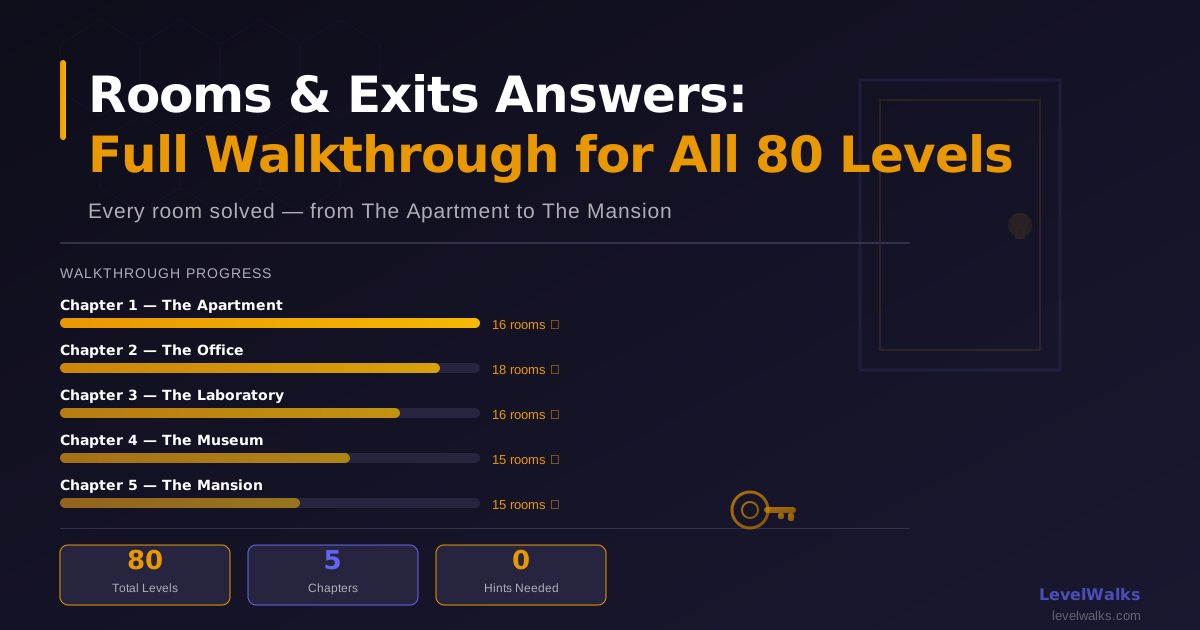
Rooms & Exits has 80+ levels across five chapters. The pattern is consistent: sweep the entire room first, collect all items before solving any locks, and trace clues explicitly to their matching puzzle. Chapter 1 (Apartment) teaches basic interaction; Chapter 2 (Office) adds multi-clue chains; Chapter 3 (Laboratory) introduces visual encoding; Chapter 4 (Museum) uses item combinations; Chapter 5 (Mansion) combines all mechanics with multi-room dependencies. Most stuck moments come from a missed clue hiding behind furniture or in a drawer you haven't tapped deeply enough — interact with everything twice.
How to Use This Walkthrough
This guide is structured in two layers. The chapter overviews give you the frameworks and dominant puzzle mechanics for each section. Reading these before playing a new chapter dramatically reduces stuck time, because you'll know what to look for. The room-specific tips dig into the exact solutions for levels that stump most players.
A note on spoilers: the framework sections are spoiler-light (they describe puzzle categories, not specific solutions). The room-specific sections contain full solutions. If you prefer to attempt puzzles independently first, read the framework section for your current chapter and only drop into the room-specific tips when genuinely stuck.
The broader guide on escape room puzzle strategies covers the meta-frameworks that apply across all chapter types, worth reading if you want to solve future rooms independently rather than following a walkthrough.
The Four Universal Rules
These rules apply to every single room across all 80 levels. Internalizing them will solve more stuck moments than any room-specific tip.
Rule 1: Sweep Before You Solve
Spend the first 60 seconds of every room tapping every visible element before solving a single puzzle. Open drawers, tap paintings, examine objects. The most common reason players get stuck is that they missed a clue and then spend 15 minutes trying to solve a puzzle with incomplete information. A full sweep first prevents this entirely.
Rule 2: Match Every Clue Explicitly
When you find a clue. A number sequence, a color pattern, a symbol. Immediately ask: what lock in this room does this answer? If you can see a matching lock, apply the clue. If not, file it as "apply after solving X." Never hold more than one unexplained clue without trying to find its matching lock.
Rule 3: Try Every Inventory Combination
If you're stuck with items in your inventory, systematically try combining each one with every other item. Rooms & Exits shows a clear visual feedback when a combination works. Items merge into a new tool. Dead-end combinations fail quietly. When you have four items and are stuck, 12 possible combinations is a few seconds of testing, not a long process.
Rule 4: Tap Deeper
Many objects in Rooms & Exits have multiple layers of interaction. A book can be tapped once to open, tapped again to reveal writing on a specific page, tapped a third time to find something tucked inside the back cover. If an object has any interactive visual response (it opens, it shifts, it zooms in), keep tapping. The clue is usually one tap deeper than where most players stop.
Chapter 1: The Apartment (Levels 1-16)
Chapter Overview
The Apartment teaches you the fundamental language of Rooms & Exits: find object, match to lock, solve. Every puzzle in Chapter 1 is self-contained, each clue solves one specific puzzle in the same room. There are no multi-step chains and no inventory combining. The difficulty is deliberately low to build intuition for the interaction model.
Common stuck points in Chapter 1 almost always trace to a missed interactive element. The apartment rooms have high object density. Shelves, drawers, paintings, books, potted plants, and the clues are hidden throughout. If you've found and applied all visible clues but can't open the exit, you missed an interactive element. Do a second sweep looking specifically at anything you've passed over as "just decoration."
Levels 1-4: The Living Room
The opening rooms introduce the core mechanic in its simplest form. Level 1 has a single puzzle: find the four-digit code and enter it in the lockbox. The code is visible in the room as a number on a framed picture. Level 2 adds a two-step sequence: you need a key to open a container, and the key itself is locked behind a color-coded lock. The color clue is on a refrigerator magnet arrangement.
Levels 3 and 4 introduce items that need to be carried: a key used on a different screen, a tool used to access a hidden compartment. This is the game teaching you that your inventory persists between areas of the same room. When you pick something up, it stays with you until used.
Levels 5-10: The Kitchen and Bedroom
The kitchen levels introduce the pattern of clues hidden inside opened containers. The code is inside the cereal box, the key is at the back of the cabinet, the symbol is under the cutting board. The interaction depth increases here: you will need to open containers, then examine the contents, then combine the contents with another item.
Bedroom levels (levels 8-10) introduce the first symbol substitution puzzles. A bedside notepad shows a cipher, symbols mapped to numbers. A locked drawer uses those symbols as the lock mechanism. The failure mode here is reading the cipher in the wrong direction. Always check whether the cipher key is showing "symbol = number" or "number = symbol". Both appear in the game.
Level 11-16: The Bathroom and Hallway
The final Apartment rooms are the most complex of the chapter. Level 13 is the first room where a clue found early in the room only makes sense after you've solved two other puzzles first. If you find something you can't immediately use, set it aside mentally. The second puzzle you solve will clarify it.
Level 16, the chapter exit room, combines everything the chapter taught: visual clue in the environment, item found in a drawer, cipher on the wall, three-input combination lock. Solve them in the order you discover them and the exit opens cleanly.
Chapter 2: The Office (Levels 17-34)
Chapter Overview
The Office introduces multi-clue chains. Puzzles where you need two or three separate clues before any of them are useful individually. You might find three items around the office that seem unrelated; the lock only becomes solvable once you realize they encode a sequence together. This is the chapter where the "sweep before you solve" rule becomes genuinely necessary. Attempting to solve puzzles mid-sweep in Chapter 2 creates confusion because partial information leads to wrong answers.
Levels 17-22: Reception and Open Office
The reception area introduces keys that unlock areas rather than just objects, you find a keycard that unlocks a door to a new section of the office, which contains clues needed for a puzzle back in the reception area. This back-and-forth between areas is new in Chapter 2. When stuck, ask whether an area you haven't explored yet contains the missing piece.
Level 20 is the first level that stumps most new players. The desk calendar shows dates with circled entries. The whiteboard shows employee names next to initials. The combination lock requires four digits. The connection: the circled calendar dates correspond to employee birthdays, and the initials on the whiteboard spell the birth month abbreviations in a specific order. Most players try to use the dates directly. The puzzle requires using the birthdays to determine the order and then extracting the day numbers.
Levels 23-28: Conference Room and Manager's Office
Conference room levels introduce multi-step item combining for the first time. Level 24 requires you to find two separate objects, combine them into a tool, and use that tool to access a hidden compartment. The individual objects look unrelated — one is a pen, one is a tube of something. But the combination creates a writing implement that activates hidden ink on a blank-looking notepad.
The manager's office levels (27-28) have the densest clue-to-puzzle density in Chapter 2. Level 28 has five separate puzzles that must be solved in sequence, each one revealing a clue for the next. Work methodically left-to-right across the room, the puzzle designer arranged the clue chain to flow naturally from the left wall to the exit on the right.
Levels 29-34: IT Room and Server Area
The IT room levels introduce digital display clues. Screens showing patterns that encode lock combinations. The key insight: when a display shows a shape or symbol, check every physical lock in the room for one that accepts shape inputs, not just number inputs. Rooms & Exits has several lock types beyond digits: directional arrows, shape sequences, color patterns, and symbol strings.
Level 34, the chapter finale, is the hardest room in Chapter 2. It requires solving a cipher puzzle whose key is distributed across three separate objects in the room, then applying the decoded message to a directional lock. The cipher is a Caesar shift by a number hidden on a sticky note. If the decoded message doesn't match any visible lock, you've decoded it in the wrong direction. Try shifting the other way.
Chapter 3: The Laboratory (Levels 35-50)
Chapter Overview
The Laboratory shifts to visual pattern recognition as the primary puzzle mechanic. You'll interpret color sequences from beaker arrangements, extract codes from the spatial positions of laboratory equipment, and decode patterns that are never written as numbers. The text-to-number translation step from Chapter 2 is replaced by a visual-to-number translation step. Players who struggle with spatial pattern recognition will find Chapter 3 the hardest in the game; players who think visually often find it easier than Chapter 2.
Levels 35-40: Sample Room and Analysis Lab
The opening laboratory rooms teach you to read left-to-right arrangements as sequences. A row of six test tubes. Red, blue, empty, yellow, empty, green, might mean positions 1, 2, 4, 6 are active, encoding the number 1-2-4-6. Or the colors each map to a number (red=1, blue=2, yellow=3, green=4), giving 1-2-3-4. Rooms & Exits always provides the color-to-number mapping somewhere in the same room. Look for a chart, a poster, or labeled sample containers.
Levels 41-46: Chemistry Lab and Storage
The chemistry lab introduces molecular diagrams as visual clues. Level 43 shows three chemical structures on a chalkboard, each labeled with a letter. A lock requires entering three letters in the correct bond order. Trace the bonds in each structure from the heaviest atom (labeled) outward, the bond sequence is the letter order. This level causes significant stuck time because players try to read the structures as chemistry rather than as a visual ordering puzzle.
Level 45 is widely considered the hardest single room in Chapter 3. A petri dish pattern encodes a four-digit number through the spatial arrangement of colony spots. Count the spots in each quadrant of the dish, then read the quadrants in clockwise order from the top-left. The critical detail most players miss: the dish has a small notch indicating "top" orientation. Rotate the clue to match the notch before counting quadrants.
Levels 47-50: Research Office
The research office levels return to more conventional puzzle structures but with the pattern recognition skills from the earlier laboratory rooms still required. Level 48 combines a symbol cipher (Chapter 2 mechanic) with a visual arrangement clue (Chapter 3 mechanic), you need to identify the cipher using a visual key, not a written one.
Chapter 4: The Museum (Levels 51-65)
Chapter Overview
The Museum introduces multi-step item chaining as the central mechanic. Puzzle chains are now four or five steps long. A tool you create in the first quarter of the room is needed to access a clue in the middle section, which unlocks a container holding another component, which combines with an earlier item to form the final key. Inventory management becomes genuinely important. When stuck in Chapter 4, the question to ask is almost always: what can I combine with what I'm holding?
Levels 51-57: Entrance Hall and Antiquities Gallery
The museum entrance establishes the new standard for interaction depth. Level 52 requires you to use an exhibit display tool (found in a cleaning closet) on a glass case to open it, retrieve an artifact, examine the artifact's base for an engraved symbol, and use that symbol as the combination for a separate lock elsewhere in the room. Four steps, four actions, no backtracking required if you find objects in the right order.
Level 55 in the antiquities gallery is famous for causing stuck moments. An ancient map on the wall appears to be decorative. It is actually a clue showing cardinal direction symbols that correspond to a directional lock on a display case. The map has faded coloring that makes it easy to overlook as environmental art. Tap it once; it will zoom in to show detail that makes the directional encoding clear.
Levels 58-62: Natural History Wing
The natural history wing introduces skeleton and fossil exhibits as visual clues. Level 59 uses a dinosaur skeleton display: count the bones of a specific type (vertebrae, ribs) to extract numbers. The correct bone type is indicated by a label elsewhere in the room. This is another "the clue isn't where you'd naturally look" design. Most players count the visible ribs without first checking what type of bone the lock's label is referencing.
Level 61 is the longest room in Chapter 4, requiring players to move between three connected gallery spaces. Items from one space are needed in another, and the clue chain loops back on itself. Recommended approach: fully clear one space before moving to the next. Carrying partial information between spaces creates confusion. Clear Space A completely, note any items or clues that seem to point elsewhere, then move.
Levels 63-65: Administrative Wing
The administrative rooms are shorter but dense, functioning as a chapter wind-down before the Mansion. Level 65, the chapter finale, combines all four mechanics in a clean final examination: basic item interaction (Chapter 1), multi-clue chain (Chapter 2), visual pattern (Chapter 3), and item combination (Chapter 4). Solve in that order and the room flows naturally.
Chapter 5: The Mansion (Levels 66-80)
Chapter Overview
The Mansion is where every mechanic from previous chapters converges. Puzzle chains are five to seven steps. Multi-room dependencies are common. You solve half a puzzle in the kitchen, find a clue in the library that completes it, and return to the kitchen with the answer. Some rooms add soft time pressure in specific sections (a mechanism activating, a door slowly closing), though these are timed generously enough that deliberate play isn't penalized.
The Mansion also introduces the first puzzles where you must recognize and exploit your accumulated knowledge from all previous chapters simultaneously. Level 73, for example, requires identifying a symbol cipher (Chapter 2 skill), reading a visual spatial arrangement (Chapter 3 skill), combining two items to create the key (Chapter 4 skill), and using that key in a specific non-obvious location (learned in Chapter 1). Players who have internalized the four universal rules from the beginning of this guide will find the Mansion challenging but fair. Players who have been using walkthroughs throughout may find it more difficult because they've been solving without building intuition.
Levels 66-70: Entrance Hall and Drawing Room
The mansion entrance reintroduces all Chapter 1 mechanics in a more complex environment. The objects are the same categories, drawers, paintings, books, decorative items. But there are more of them, and the relevant ones are distributed across a larger space. Level 67 has eight interactive objects, only four of which are relevant to the current puzzle chain. The other four are either red herrings or elements that become relevant later. Tapping everything is even more important here — you need to have examined all objects to know which four matter.
Levels 71-75: Library and Study
The library levels are where the Mansion earns its difficulty reputation. Level 72 requires extracting information from three books in the library to decode a combination that opens a secret compartment in the study. A different room entirely. The books are on different shelves, one is partially hidden behind another, and the combination requires reading a specific page number from each book and arranging the page numbers in an order given by the study's clock face.
Level 74 is the hardest individual room in the game for most players. A grandfather clock, a star chart, a sheet of music, and a globe each contribute one digit to a four-digit safe combination. The clock contributes hours, the star chart contributes a constellation number, the sheet music contributes a note count, and the globe contributes a latitude coordinate. None of these connections are labeled, you figure them out by identifying what each object can tell you that's quantifiable, then checking whether any lock accepts four-digit input.
Levels 76-80: Upper Floors and Final Room
The upper floor levels increase room-to-room dependencies. Level 78 is split across three connected bedrooms, with each room holding one component of a three-part key. The components combine in the correct order (determined by a color code painted on the corridor wall) to form the final master key. Combining them in the wrong order creates a tool that doesn't open any lock. The game gives no error message, which is how players end up trying every wrong combination before reconsidering the order.
Level 80, the final room, is the best puzzle in the game. It is a fully integrated escape room challenge that uses every mechanic from every chapter in sequence. The room is large, with five puzzle chains running in parallel. Some blocking others, some independent. The recommended approach is to solve what you can immediately upon entering, note what requires more clues, and return to incomplete puzzles as other puzzles yield new information. The room is designed so that solving puzzles in a natural exploration order progresses all five chains simultaneously without ever being completely stuck.
The Rooms & Exits chapter overview walkthrough covers the structural logic of each chapter for players who want strategic frameworks rather than step-by-step solutions.
Puzzle Type Reference Guide
When you know what puzzle type you're looking at, the solution approach becomes automatic. Use this as a quick-reference when you encounter an unfamiliar puzzle in any chapter.
| Puzzle Type | What It Looks Like | First Question to Ask |
|---|---|---|
| Digit code | Numeric keypad or combination dial | Where is a sequence of numbers in this room? |
| Symbol cipher | Lock with non-numeric symbols | Is there a chart, poster, or label that maps symbols to numbers? |
| Color sequence | Lock with colored input buttons | What colored objects are in the room, and what order are they in? |
| Directional | Lock with arrow inputs | Is there a map, path, or movement diagram showing a direction sequence? |
| Visual pattern | Grid selection or shape input | What shapes or grid patterns exist in the room that match the input type? |
| Item combination | Object that seems unusable alone | What else in my inventory could combine with this? |
| Hidden interaction | Object that doesn't respond to one tap | Have I tapped this multiple times? Have I tried combining inventory items with it? |
Frequently Asked Questions
How many rooms does Rooms & Exits have in total?
The base game has 80 levels across five chapters. Seasonal content and additional chapter releases have expanded this, with some players reporting 100+ rooms available in fully updated versions. The chapter structure (Apartment, Office, Laboratory, Museum, Mansion) covers the core 80 levels. Additional content follows the same chapter structure and uses the same puzzle mechanics. This walkthrough's frameworks apply to all of it.
I'm stuck on a level and can't figure out what I'm missing. What should I do?
Run through the four universal rules in order. First: sweep the entire room again, there is almost certainly an object you haven't interacted with fully. Look specifically at the floor, at object backs and undersides, and at anything that zooms in when tapped (it may have a second layer of interaction). Second: check your inventory. Is there anything you're carrying that you haven't tried using on every interactive surface? Third: if you have multiple inventory items, try every combination. Fourth: if you have a clue but no matching lock, keep it in mind while doing a full room sweep. The lock is somewhere you haven't tapped yet.
Are the answers in Rooms & Exits random or the same every time?
The puzzle structure and most specific answers are fixed, the same code opens the same drawer every time you replay a level. A small number of levels use values that vary per playthrough (particularly in later chapters where clues reference in-room details that might randomize). For these levels, walkthroughs describe the method for finding the answer rather than the answer itself. The majority of the 80 base levels have consistent answers.
Is it possible to get completely stuck with no way forward?
No. Rooms & Exits does not have unwinnable states. Every room always has a solution from any configuration. The game prevents you from irreversibly misusing items or permanently closing off puzzle paths. If you feel completely stuck, it's a perception problem (you're missing something that is available) not a game-state problem. The built-in hint system can provide a single nudge toward the next step if you want confirmation you haven't broken anything.
What is the hardest level in the game?
Community consensus points to Level 74 in the Mansion (the grandfather clock, star chart, globe combination room) as the single hardest level, primarily because the puzzle gives you no indication of which features of each object are relevant. Level 45 in the Laboratory (the petri dish with the orientation notch) is a close second, straightforward once the orientation detail is noticed, but invisible to most players on first encounter. Level 80 (the final room) is long and complex but fairer than either of those two, because the connections between clues and locks are more clearly telegraphed.