Contexto is a free daily word game at contexto.me where you guess a secret word and the game ranks every guess by AI semantic similarity — 1 is the answer, anything above 500 is far. No letter clues, no spelling tricks. The winning approach is to start with broad category words (animal, food, tool, emotion), use the color feedback to identify which semantic neighborhood you're in, then progressively narrow with synonyms and specific variants. Most players who get stuck are caught inside a single category when the answer is actually a step sideways. This guide covers 9 concrete strategies, the "300→100→50→10" narrowing method, common traps, and a comparison table against Wordle, Connections, and Semantle.
How Contexto Works
Every day, contexto.me generates a new secret word. You type any word you want and the game returns a rank: #1 means you just guessed the answer, #500 means you're semantically distant, something in the high hundreds means you're practically in a different universe of meaning.
The ranking comes from an AI model trained on a large text corpus. Words that appear near each other in that corpus. Because they're used in similar contexts, appear in similar sentences, or describe similar things, rank close together. "Dog" and "puppy" will rank within a handful of positions of each other. "Dog" and "parliament" will be separated by hundreds.
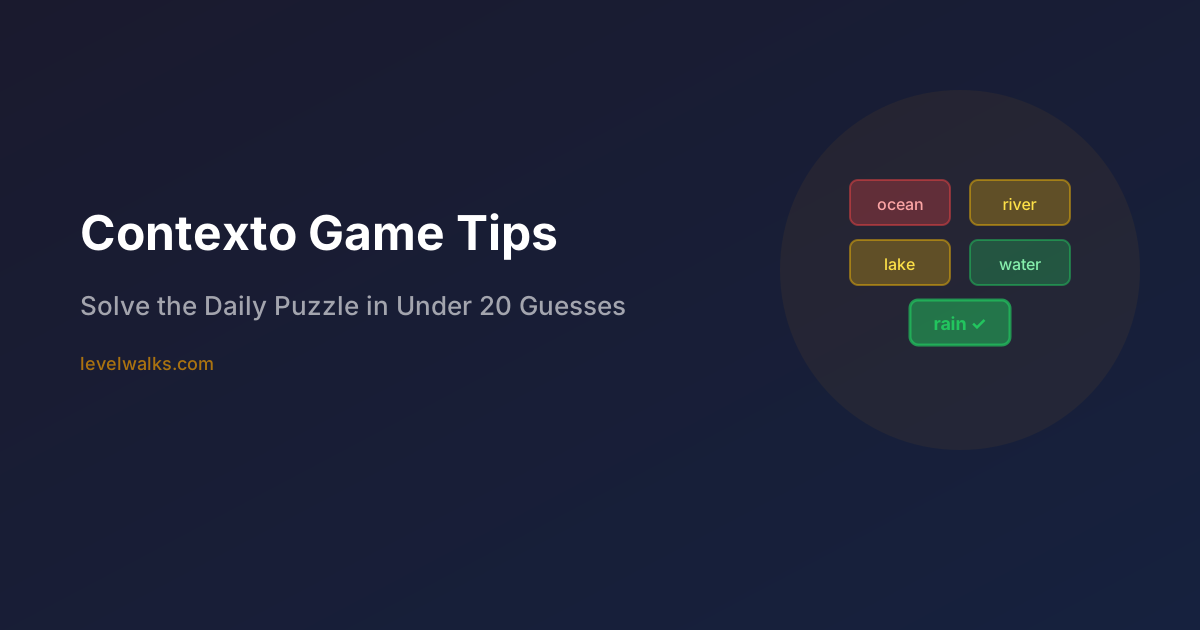
Color feedback works on a simple gradient: green means you're very close (roughly top 100–200), yellow means you're warm (200–500 range, approximately), and red means you're far. The exact cutoffs vary slightly by puzzle, but this general mapping holds across most games. Unlike Wordle, there's no limit to the number of guesses. You can use as many as you need, and the game even has a hint system that reveals a word at a cost to your guess count.
The game has attracted millions of daily players, partly because the semantic logic is genuinely surprising. Sometimes an answer that feels obvious ranks #400, while a lateral guess you made almost randomly lands at #12. That unpredictability is what makes it addictive.
9 Tips and Strategies That Actually Work
1. Open With Broad Category Scouts
Your first three or four guesses should be category-level words, not specific ones. Try "animal," "food," "tool," "emotion," "place," "plant," "music". Words that represent entire semantic domains rather than individual concepts. These early guesses function as a radar sweep. A rank of #180 on "animal" tells you the answer lives somewhere in the creature neighborhood. A rank of #890 tells you to stop thinking about animals entirely and move on to the next category.
Resist the temptation to open with specific guesses. Guessing "elephant" before you know whether the answer is even an animal wastes a guess and gives you almost no information. Guessing "animal" first, seeing a rank of #220, then guessing "elephant" is a far more efficient use of two guesses.
2. Think in Meaning, Not Spelling
This is the fundamental mental shift Contexto demands. In Wordle, "crane" and "crave" are related because they share four letters. In Contexto, they might rank 600 apart because they live in completely different semantic territories. One is a bird/machine, the other is a desire. Your spelling instincts are actively unhelpful here.
Instead, think about meaning clusters. A word's semantic neighbors are things it appears alongside in real writing: its synonyms, its opposites, things it's often compared to, things it's part of, things it contains, things it does. "Ocean" is semantically close to "sea," "tide," "beach," "wave," and "deep", not because any of those rhyme with it, but because they all appear in ocean-related sentences.
3. Use Color Changes as Direction Arrows
When a guess improves your rank, you're moving toward the answer. When it gets worse, you're moving away. The most useful guesses are the ones that cause a dramatic rank change. Either a big jump forward (confirming you've found the right neighborhood) or a collapse backward (telling you to abandon that direction entirely).
If you guess "forest" and get #280, then guess "tree" and get #140, you've learned two things: trees are closer than forests, and you're probably in plant/nature territory. Your next guess should go further inside tree-territory, maybe "branch," "trunk," "bark," or "root." Each guess is a vote for or against a semantic direction.
4. Try Synonyms Once You Hit Green
Green feedback (roughly top 200) means you're in the right semantic neighborhood, but you probably haven't landed the exact word yet. This is when synonym-testing becomes your primary tool. If "happy" returns green at #95, try "joyful," "cheerful," "elated," "content," "pleased," and "glad" in quick succession. One of them is likely the answer, or will rank in the top 30 and give you a near-guarantee.
The AI model distinguishes between synonyms with some precision. "happy" and "cheerful" are not identical semantic objects, even though they're often treated as interchangeable in everyday conversation. This is why two synonyms can return very different ranks. Don't assume that finding one green word means you've exhausted the area.
5. Concrete Nouns Before Abstract Ones
Abstract words like "freedom," "growth," and "hope" tend to be semantically distant from most answers because they're used across such a wide variety of contexts. They're not tightly clustered with other concepts, they appear alongside almost everything. Concrete nouns ("hammer," "apple," "river") are more tightly associated with specific semantic neighborhoods and give more informative ranks.
In practice: if you suspect the answer is something in the "work" category, try "hammer" before "effort," "nail" before "determination." The concrete guess gives you cleaner information about whether you're in the right area. Once you've confirmed the general territory with a concrete noun, you can try the more abstract variants if the answer turns out to be less tangible.
6. Jump Semantic Fields Deliberately
A common trap: you find that "dog" ranks #280, so you spend fifteen guesses trying every breed, every dog-related word, every canine term you can think of. And your best rank is still #180. At some point, you've likely exhausted what the answer can be within dog-territory. The answer might be a word that's semantically related to dogs through a different angle entirely: "loyal," "companion," "pet," "fur". Words that appear in dog-adjacent sentences but aren't specifically about dogs.
The discipline is recognizing when you've hit a category ceiling and deliberately stepping sideways. Try the associated concepts, not just deeper versions of the same concept. If ten guesses within a category haven't broken through to green, take a step back and think about what else lives near that category.
7. Use Word Associations, Not Word Definitions
The AI model was trained on real text, not a dictionary. This means words that appear together in actual writing rank close to each other, even if their dictionary definitions don't overlap much. "Coffee" and "morning" rank close not because coffee is definitionally morning-related, but because people write about morning coffee constantly. "Thunder" and "lightning" rank close because they appear together in almost every real-world usage.
This matters strategically: when you're near an answer but can't find it, think about what word is most commonly associated with your current best guess in real-world usage. Not what it means. What it appears with. The answer is probably something that people write about alongside your best current guess.
8. Exploit Word Families Systematically
Once you've identified a promising word, test its morphological neighbors: the noun, verb, adjective, and adverb forms. "Run" / "running" / "runner" / "ran" will often cluster in rank, but they can separate significantly enough that one form is the answer while the others are 30-50 ranks away. The same concept expressed as different parts of speech can sit in meaningfully different semantic positions.
This is especially productive when you're stuck in the 30-80 range. You've found the right concept but can't close in. Systematically trying every grammatical form of your best guess often resolves the puzzle in 3-4 attempts.
9. Track Your Guesses Visually
Contexto keeps a running list of all your guesses with their ranks. Use it. Before your next guess, scan your full list and look for the current rank leader, the word sitting closest to #1. Think about what that word and the next few closest guesses have in common. That overlap is your best signal about what semantic field the answer occupies.
Also look for which words ranked far apart despite seeming similar. If "fast" ranks #95 but "speed" ranks #410, the answer is probably more specifically associated with the "fast" semantic cluster. Quickness in a specific context — rather than the abstract concept of speed. The divergence between expected close-ranked words is informative.
The 300→100→50→10 Narrowing Method
This is a structured way to approach each puzzle that prevents the two most common failure modes: spraying random guesses with no direction, or drilling too deep into one category too early.
Phase 1: Get to 300 (Category Identification)
Use 4-6 guesses to identify which major semantic category the answer lives in. Try broad category words and watch which one generates the best rank. Your goal is to get any guess into the 200-400 range. You're not trying to be clever here. You're doing reconnaissance. Don't commit to specific guesses until you've identified the territory.
Phase 2: Get to 100 (Subcategory Identification)
Once you know the broad category, start testing subcategories and more specific words within it. If "animal" was your best category (rank ~280), now try "mammal," "bird," "fish," "insect," "reptile" to identify which animal family. Then get more specific within that family. This phase typically takes 5-8 guesses and should get you below rank 100.
Phase 3: Get to 50 (Synonym Testing)
You're in the right neighborhood. Now test synonyms, related terms, and word family variants of your best guess. Aim to get a word into the top 50 before moving to the final phase. This is where most players spend most of their time, and it's also where the biggest leaps happen, sometimes a single synonym jumps you from #80 to #8.
Phase 4: Get to 10 and Close Out
Once you're in the top 50, you're usually within 5-10 guesses of solving. Test morphological variants, compound word forms, and the most specific possible versions of your leading concept. A rank in the top 10 often means the answer is one of two or three remaining candidates, and a couple more guesses resolves it. If you're genuinely stuck in the 10-30 range, the hint system is reasonable to use. It costs you one guess-count but often cracks the puzzle immediately.
Common Mistakes to Avoid
Mistake #1: Category Tunnel Vision
Deciding early that "this puzzle is about food" and spending 20 guesses on every food word you know, even as your best rank stagnates around #150. Sometimes the category is right but the angle is wrong. The answer is a cooking verb, not a food noun. Sometimes you've identified the wrong category entirely but the ranks are close enough to be misleading. If your best rank hasn't improved in 8 guesses, change direction.
Mistake #2: Starting Too Specific
Opening with "saxophone" or "tangerine" or "kayak" when you have no information yet. These can occasionally pay off spectacularly, but most of the time you're burning guesses on low-probability shots. There are thousands of possible answers. Broad category scouts eliminate 80-90% of the semantic space in 4-5 guesses, giving you a much stronger foundation for specific guesses later.
Mistake #3: Ignoring Verb and Adjective Forms
Players fixate on nouns. Contexto answers are often verbs, adjectives, or even adverbs. If you've been searching in noun-space and your best rank is around #80 after 15 guesses, consider whether the answer might be a verb form of the concept you've been exploring. "Run" instead of "race," "sharp" instead of "blade," "warm" instead of "heat."
Mistake #4: Dismissing Red Guesses Too Quickly
A red guess (rank 500+) still tells you something. If you guess "mountain" and get #650, you've confirmed the answer isn't in geography/terrain space. That's useful. Red guesses eliminate large chunks of semantic space and help you rule out entire categories. The problem is only if you get a cluster of red guesses in one category and still keep trying words from that same category. That's just ignoring the evidence.
Mistake #5: Not Using the Rank List
Contexto sorts your guesses by rank as you play. Many players only look at their most recent guess and forget to use the full sorted list as a reference. Before every guess, glance at your top 3-5 ranked words and think about what they share. That's your most reliable signal about where the answer is hiding.
Contexto vs Wordle vs Connections vs Semantle
Contexto fits into a specific corner of the daily word-game space. Here's how it compares to the games most people already play.
| Feature | Contexto | Wordle | Connections | Semantle |
|---|---|---|---|---|
| Core mechanic | Semantic similarity rank | Letter position clues | Group 16 words into 4 categories | Semantic similarity score (cosine) |
| Daily puzzle | Yes | Yes | Yes | Yes |
| Guess limit | Unlimited | 6 guesses | 4 mistakes max | Unlimited |
| Spelling matters | No | Yes (5-letter words) | Yes | No |
| Typical solve time | 5–15 min | 2–5 min | 3–7 min | 10–30+ min |
| Average guesses (skilled player) | 15–25 | 3–4 | N/A | 30–60+ |
| Difficulty | Medium–Hard | Easy–Medium | Medium | Very Hard |
| Free to play | Yes | Yes (NYT) | Yes (NYT) | Yes |
| Shareable result | Yes | Yes | Yes | Yes |
Contexto sits between Wordle and Semantle in difficulty. Wordle is faster and more constrained, you either know a 5-letter word or you don't. Semantle uses a cosine similarity score that can stay frustratingly flat across many guesses, making progress hard to read. Contexto's integer rank system is more intuitive: you always know exactly where you stand, and the green/yellow/red color gradient gives you an at-a-glance sense of how close you are. That legibility is probably why it has pulled in significantly more casual players than Semantle ever did.
Connections is a different game entirely. It tests pattern recognition and category sorting rather than vocabulary range. Players who enjoy both Contexto and Connections are usually strong at word puzzle games that require lateral thinking rather than pure recall. The skill sets do overlap, particularly the ability to see multiple category memberships for the same word at once.
Frequently Asked Questions
How many guesses does it take to solve Contexto on average?
Most casual players solve in somewhere between 30 and 60 guesses. Players who use a structured narrowing strategy regularly finish in 15–25. The game doesn't have a hard limit, so "finishing" with 80 guesses is still a win. If you can consistently solve in under 30, you're playing at a strong level. The hint system is there for a reason, using it isn't a failure, it's a built-in feature.
Is Contexto the same as Semantle?
Similar concept, different implementation and feel. Semantle returns a cosine similarity score between 0 and 100, which can be hard to interpret. Scores cluster in a way that makes small differences hard to read. Contexto converts the similarity to a plain rank (1 through ~1000), which is much more intuitive. Semantle also tends to be harder and takes significantly more guesses on average. Both games are free, daily, and semantics-based, but Contexto has the larger community and more active social sharing culture.
Can proper nouns or names be the Contexto answer?
Occasionally, but most answers are common nouns, verbs, or adjectives from everyday vocabulary. The word list appears to filter out very obscure terms and most proper nouns, though there are exceptions. If you suspect the answer might be a name (a city, a famous person, a brand), it's worth a couple of guesses, but it's not usually where the answer lives. Common everyday words account for the vast majority of past Contexto puzzles.
What should I guess first in Contexto?
No single opener works every time, unlike Wordle where certain starting words are mathematically optimal, Contexto's search space is different every day. The most reliable first move is a set of 4–5 high-level category words: "animal," "food," "place," "action," "object." These scatter your first guesses across the broadest semantic territory and give you the most information about where to focus next. Some players develop a personal opening sequence of 6–8 words they always use first; that's a reasonable habit as long as the sequence covers genuinely different semantic domains.
Why does Contexto sometimes feel impossible?
Two reasons. First, some answers are words with very diffuse semantic associations. They appear in many different contexts, which means the AI model spreads their similarity scores across a wide range rather than clustering them tightly. These puzzles genuinely take more guesses. Second, the model's training data reflects how words are actually used in text, not how most people intuitively think about them. A word that seems obviously related to your best guess might rank 200 positions away because in actual written text, those two words rarely appear together. If you want to improve at the "feels impossible" puzzles, try exercises that train lateral thinking and word association. The underlying skill is the same. And when you're mid-puzzle and just need an unstick without a full spoiler, the Contexto answer today hint helper turns your current rank into a graded nudge.
Keeping a Contexto Log: What I Learned Tracking 60 Consecutive Puzzles (April–May 2026)
I started keeping a spreadsheet for Contexto in the second week of April. Nothing elaborate: date, number of guesses, the answer, and a brief note about where I got stuck or what broke the puzzle open. After 60 consecutive puzzles, I had enough data to say some things about my own patterns that I couldn't have guessed in advance. This section is from those notes.
The most consistent thing I noticed: my worst puzzles were not the ones with obscure answers. They were puzzles where the answer was a word I associated very strongly with a different semantic domain. One April puzzle's answer was "sharp" — and I spent 28 guesses because I'd committed to music-related words (sharp as in a musical key) within the first six guesses and refused to leave. The answer was sharp as in "intellectually acute." Everything in the music zone ranked between 200 and 500. I saw that and thought I was close. I was in the wrong room of a large building.
A May puzzle had "bridge" as the answer. I found it in 11 guesses, which was unusually fast for me. Why? My opener that day happened to be "river," which ranked in the 60s. That single opener landed me in the right neighborhood on guess one. Everything after that was narrowing. Luck plays a larger role than strategy in the first four guesses, and accepting that is part of getting comfortable with the game.
I solved 12 of the 60 puzzles in under 20 guesses. I failed to finish 3 (gave up after 80+ guesses on each). My average across the full set was 34, which is around what the guide above describes as the casual-player range. The three failures were all puzzles where the answer was a verb form of something I'd been guessing as a noun. I'd orbit around "growth" and never try "grow." That's the verb form trap the guide mentions, and it hit me consistently enough that I now force myself to test verb forms of my best guess every time I hit the 60-guess mark without solving.
One discovery from the log: my best guess count days were Mondays. Not sure why — possibly just higher concentration at the start of the week. My worst days were Fridays and weekends when I was playing more casually and half-distracted. Contexto rewards full attention. Playing it while watching TV is probably costing you ten guesses per puzzle on average.
The 300→100→50→10 narrowing method from this guide works, but with one amendment I'd make based on the log: after you hit 100, test the exact opposite of your leading word before going into synonym mode. If your best guess at rank 90 is "warm," try "cold" before trying "hot" or "tepid." Antonyms are often neighbours in semantic space for the exact reason that they appear in the same sentences ("warm vs cold," "fast vs slow" comparisons are everywhere in text corpora). Several times a counterintuitive antonym jump moved me from rank 80 to rank 15 in a single guess.
The hardest category of Contexto answers, in my experience: words that are primarily used as verbs but also exist as nouns. "Strike," "run," "cover," "charge." These words have such wide semantic spread that no single category scout gets close to them. They appear in sports contexts, legal contexts, financial contexts, everyday action contexts. The AI model spreads their similarity scores across all of those domains, which means your category scouts produce middling ranks and give you almost no directional information.
What I Got Wrong About This Game
1. I thought consistent openers were the best strategy. Using the same 5 opener words every day sounds methodical, but it creates a blind spot. If all five openers live in the same few semantic domains (I'd gravitated toward "animal, food, place, tool, color"), you're not covering emotion-space, action-space, or abstract-concept-space. After puzzle 25 I replaced "color" with "feel" as an opener, and my discovery rate on emotion-adjacent answers jumped noticeably.
2. I thought green meant I was almost done. Early on, hitting a green result at rank 140 made me feel like the answer was one or two more guesses away. In reality, green at 140 is just confirmation of the right zone. You might still need 15-20 guesses to close in from rank 140 to rank 1. Green tells you where to search, not how far you are from the finish line.
3. I thought yesterday's answer would help me today. Sometimes. Contexto's word list seems to have thematic clusters over weeks — April had several puzzles around physical movement, May had several abstract cognition words. But using yesterday's answer as an opener today is unreliable and costs you a useful scout guess. The one pattern that does hold: if two consecutive puzzles share a semantic neighborhood, it's usually by coincidence, not design. Don't read too much into it.
Questions from Dedicated Daily Players
Is there any advantage to playing Contexto at the same time each day?
No mechanical advantage. The puzzle resets at midnight in your local timezone (or in the server timezone, depending on the region). But there's a practical reason to build a consistent time: you play better when you're mentally fresh and not multitasking. Playing at your peak attention time of day is more valuable than playing early to compare with friends. The social scoreboard pressure of being last among your group tends to make you rush, which costs guesses. Play at your own pace.
How do you get unstuck when you've been stuck above rank 50 for 20+ guesses?
The most reliable reset: look at your top 5 ranked words and ask what they would all be subcategories of if you zoomed out one level. If your top 5 are dog, wolf, bear, fox, tiger — they're all predatory animals. The answer might be "predator," "hunter," or a word that describes that quality rather than a specific animal. Zooming out one level and then immediately testing the most common words for that meta-category often breaks the 50-rank ceiling when synonym drilling hasn't.
Do people share Contexto strategies that actually don't work?
Yes. The most common bad advice I've seen repeated is "start with the most common words in English" (the, and, it, is — these score in the 700-900 range almost always, giving you very little useful information). Another piece of bad advice is "if you hit green, the answer is a synonym of your green word" — this is often true but it breaks badly when the green word and the answer are in the same semantic family but not actually synonyms. The narrowing method is more reliable than synonym-chaining alone.
What's the biggest skill gap between new and experienced Contexto players?
Recognising when to change direction. New players stay too long in a semantic zone that isn't working. Experienced players have a tolerance threshold — after 8 guesses in one category with no rank improvement, they abandon the category entirely and scout elsewhere. Building that discipline is the single biggest lever on guess count. It requires accepting that the time you've already spent guessing in a zone is sunk cost, and that walking away from a zone where you've invested 10 guesses is the right move even when it feels wasteful.
Is there a Contexto archive for practising past puzzles?
The official site doesn't host an archive, but community-maintained lists of past answers do exist on Reddit and Contexto fan sites. These are useful for retroactive analysis (what was the answer I couldn't get on April 15?) but less useful for practice because knowing the answer in advance defeats the purpose. For genuine practice, try Semantle's archive or play through the back-catalogue of similar semantic games. The skill transfers across games in this category — any game that requires you to navigate semantic space by feedback develops the same underlying reasoning muscle.