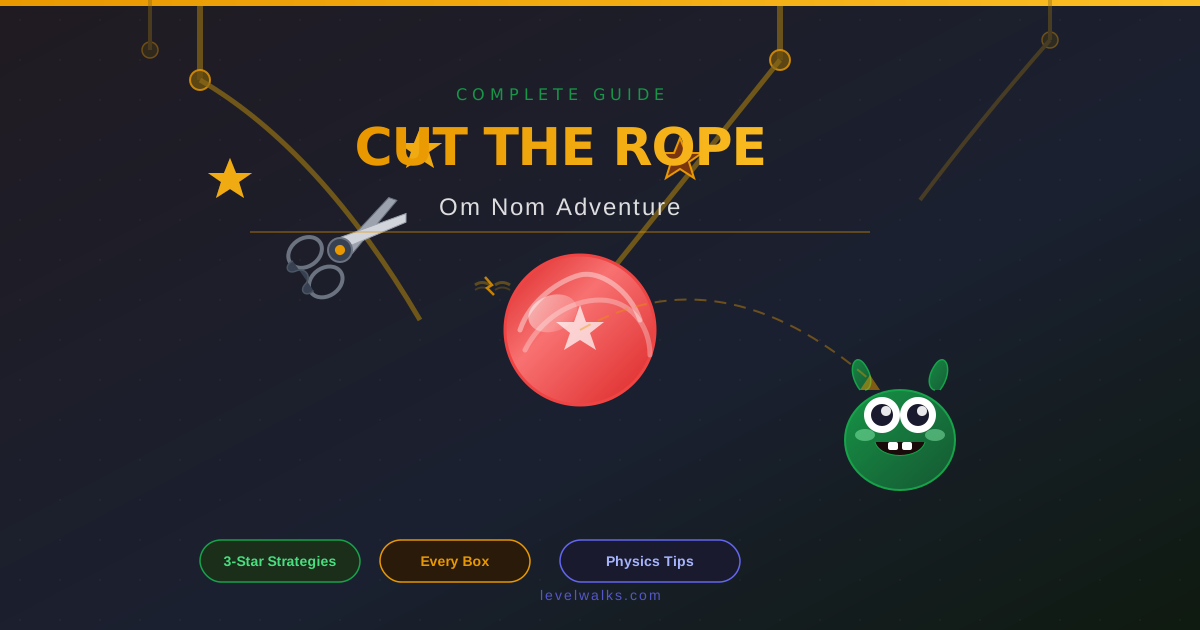
Cut the Rope is a physics puzzle game where you cut rope segments to swing a candy into Om Nom's mouth while collecting three stars along the path. Each of the 15 candy boxes introduces a new mechanic — bubbles, spikes, teleporters, magic hats. The difficulty lies not in the cutting itself but in sequencing your cuts and using the environmental tools in the right order. This guide covers every box's dominant mechanic, the three-star philosophy, and specific strategies for the levels most players replay.
Om Nom and the Core Mechanics
Om Nom is the small green creature who needs candy in every level. He sits in a fixed position, usually at the bottom of the screen or in a defined area. And the candy must reach him to complete the level. Completing a level just by feeding Om Nom earns one star. Collecting all three stars on the path to Om Nom earns the maximum score.
The candy always starts attached to at least one rope. You cut ropes by swiping your finger through them. This is the entire control scheme, swipe to cut, occasionally tap to interact with environmental objects. The complexity comes entirely from physics and sequencing.
Physics You Need to Understand
- Candy swings on the rope like a pendulum. Cutting a rope at the right moment of the swing sends the candy in a specific direction. Cutting at the wrong moment sends it the wrong way. Learn to read the swing arc before cutting.
- Gravity is always active. When you cut the last rope, the candy falls. Where it falls depends on the angle and momentum at the moment of the cut. A stationary candy falls straight down.
- Multiple ropes change the physics. When two ropes hold the candy at different angles, the candy hangs at an averaged position between them. Cutting one rope changes the swing axis immediately.
- Environmental objects interact with momentum. Bubbles add upward force. Air cushions redirect the candy. Bouncy walls reflect it. Each new mechanic introduced in a box modifies the physics model. Understanding how before you start a level saves a lot of retries.
The Three-Star Philosophy
Most players learn the wrong lesson from their first failed three-star attempt: they assume the stars require a lucky arc. Stars almost never require luck. They require planning the candy's path before touching anything.
Before making a single cut:
- Map the star positions. Are they in a row that a single arc can cover? Are they at different heights requiring multiple swings? Knowing the layout first changes which rope you cut first.
- Identify the feeding position. Om Nom needs to receive the candy at a specific point. Work backwards, where does the candy need to be on its final arc to reach him? Which rope cut creates that final arc?
- Find the dependency chain. In most levels, there is a correct order: cut Rope A to swing candy through Star 1, wait for the swing to reach the apex, cut Rope B to reach Star 2, then let momentum carry the candy to Om Nom. The sequence is fixed; only the timing is variable.
Three-star solutions almost always exist as a single smooth sequence of cuts with intentional timing pauses between them. If you find yourself making rapid consecutive cuts, you are likely off the correct path.
Cardboard Box. Learning the Swing
The Cardboard Box is the tutorial environment. Rope cutting only, no special mechanics. Every level here is designed to teach a specific aspect of pendulum physics. Do not rush through it looking for difficulty; these levels encode the intuitions you will rely on for everything that follows.
Dominant mechanic: Pendulum timing
The key skill the Cardboard Box teaches is waiting. Most players' first instinct is to cut ropes immediately. The correct approach is to watch one full swing cycle, identify the arc that passes through the stars, and cut at the peak of the swing in the correct direction.
Levels Worth Studying
Level 1-4. Two Ropes, Three Stars in a Line
The stars are arranged in a diagonal path that matches the candy's swing arc when hanging from the left rope only. Cut the right rope first. The candy swings left. At the apex of the leftward swing, when the candy is momentarily still. Cut the left rope. The candy drops through the remaining two stars onto Om Nom. Do not cut both ropes simultaneously.
Level 1-8 — Stars at Different Heights
This is the first level that requires the candy to travel through two separate arcs to collect all stars. The top star requires the candy to be high on the swing. The bottom star requires it to be low. Cut the long rope to swing wide and collect the top star, let the candy reach the bottom of that arc to collect the middle star, then cut the short rope at the correct moment for the bottom star and Om Nom. This level introduces the concept of "partial path" planning.
Fabric Box. Bubbles
The Fabric Box introduces bubbles. Bubbles attach to the candy when it makes contact and carry it upward against gravity. You pop bubbles by tapping them or by pressing them against sharp surfaces (spikes, edges). Understanding bubbles reverses your instinct: sometimes the goal is to get the candy as high as possible first, then drop it.
Dominant mechanic: Bubble control
Bubbles introduce vertical movement that ropes cannot provide. When the candy is floating upward inside a bubble and you cut its rope, it continues rising until it pops the bubble or you tap to pop it manually. The skill here is knowing when to pop, too early and the candy falls short, too late and it floats past Om Nom.
Levels Worth Studying
Level 2-3. Bubbles Against the Grain
Om Nom is positioned above the candy's starting point. This is the first level where gravity works against the obvious solution. Get the candy into the bubble by swinging it to the bubble's position. Once the bubble lifts the candy above the lower two stars, cut the rope so the candy stops rising but has forward momentum. Pop the bubble by tapping it when the candy is level with Om Nom's mouth. The timing between the cut and the pop is tight. Maybe half a second.
Level 2-9. Multiple Bubbles
Two bubbles are positioned at different heights, and all three stars form a vertical column. The approach: get the candy into the lower bubble first, let it rise through Star 1 and Star 2, then pop the lower bubble so the candy continues rising into the upper bubble via momentum, collects Star 3, then pop the upper bubble when the candy is aligned with Om Nom. Popping the wrong bubble first collapses the sequence. If the candy falls after the first pop, you released too early.
Foil Box, Spikes and Timing
The Foil Box adds spikes. Instant-fail surfaces that destroy the candy on contact. This forces you to plan paths around obstacles, not just toward Om Nom. Spikes also pop bubbles on contact, which can be used deliberately to drop the candy at a specific height.
Dominant mechanic: Obstacle avoidance and intentional spike use
The initial instinct is to avoid spikes completely. The advanced skill is using spikes purposefully to pop bubbles at exact positions. When a star cluster is surrounded by spikes, the intended path is often to carry the candy in a bubble to a precise height, graze the spikes to pop the bubble, and let the candy fall through the star cluster onto Om Nom.
Levels Worth Studying
Level 3-5, Spike Corridor
The candy must swing through a narrow corridor between two spike beds. The rope length determines exactly how wide the swing arc is. Before cutting any rope, visually trace where the candy will swing. If the arc clips the spikes, you need to cut a different rope first to change the arc width. Almost every retry here comes from cutting without tracing the arc first.
Level 3-12. Deliberate Spike Pop
One star is positioned such that the only path through it requires the candy to be inside a bubble near a spike ceiling. The intended solution is to float the bubble upward, let it contact the spike ceiling, pop at that exact height, and fall through the star. Players who try to manually tap the bubble always pop it too early. Let the physics do the timing, the spike pops it for you at exactly the right height.
Magic Box. Hats and Teleporters
The Magic Box is the most complex environment in the game's original build. Magic hats act as teleporters: a candy that enters one hat exits from another. Multiple hats in a level create a portal network, and planning routes through this network while collecting stars is the dominant challenge.
Dominant mechanic: Portal sequencing
Hats are color-matched pairs. The candy enters one hat of a pair and exits the other with its velocity and direction preserved. Understanding that momentum transfers through the hat is critical. A candy entering a hat at speed exits the paired hat at the same speed in the equivalent direction. This lets you change the candy's horizontal position while preserving vertical momentum, or vice versa.
Levels Worth Studying
Level 4-6. Two Hat Pairs
Two pairs of colored hats create four possible portal routes. The three stars require using both pairs in sequence. The correct path: enter the blue hat (carries candy left), exit on the right side through Star 1, enter the red hat (carries candy up), exit at the elevated position through Stars 2 and 3, then cut the final rope for Om Nom. Entering the red hat first wastes both transitions and leaves Star 1 uncollectable.
Level 4-15, Hat Chain
This level chains three hat pairs. The candy passes through all three to reach Om Nom, with stars positioned at each exit point. The challenge is that the candy carries momentum between hats, so entering a hat at the wrong angle sends it through the chain in the wrong direction. The correct entry angle for the first hat is slightly leftward, not straight down. This counterintuitive entry angle straightens out after the first transition.
Valentine's Box — Hearts and Added Complexity
The Valentine's Box combines all previously introduced mechanics. Bubbles, spikes, and hats, in levels with a Valentine's theme. It is generally the most challenging box in the base game due to the combination density.
Approach for combination levels
When multiple mechanics are active simultaneously, break the level into phases. Which mechanic do you use first? Almost always: handle the mechanic with the least control (bubbles move on their own; hats are fixed; ropes you control). Manage the uncontrolled elements early and use the controlled elements to clean up.
General Strategies That Apply Everywhere
| Problem | Strategy |
|---|---|
| Candy keeps missing Om Nom | Trace the candy's predicted arc from the cut point. You are almost certainly cutting at the wrong phase of the swing |
| Can collect 2 stars but not the 3rd | The 3rd star likely requires a different rope to be cut first. Re-plan the sequence from the start |
| Bubble pops too early or too late | Use spikes to auto-pop at a fixed height instead of tapping manually. More precise |
| Candy exits hat in wrong direction | Entry angle into the hat = exit angle from the paired hat. Adjust how the candy enters the first hat |
| Level seems physically impossible | There is always a solution. Check if any background element is interactive (some anchors can be tapped to move) |
| Stars are at heights that seem unreachable | Bubbles can reach any height; check if a bubble spawner is present that you overlooked |
The Single Most Important Habit
Pause before every level. Look at the full scene for ten seconds before touching anything. Identify: Where is Om Nom? Where are the stars? What mechanics are present? What is the likely dependency order? This ten-second pause replaces roughly five minutes of random retries on difficult levels. It sounds obvious and almost nobody does it consistently.
Cut the Rope vs Other Puzzle Games
Cut the Rope occupies a different niche than games like Brain Test or Rooms and Exits. It is a pure physics puzzle, there is no lateral thinking or misdirection. The challenge is always spatial and sequential. Once you understand the physics model, any level is solvable by analysis. This makes it easier to return to after a break than games that require recalibrating lateral thinking instincts.
Frequently Asked Questions
How many levels does Cut the Rope have?
The original Cut the Rope shipped with around 300 levels across multiple candy boxes. ZeptoLab has added content through updates over the years. The remastered versions and sequel (Cut the Rope 3) have expanded the level count significantly. For the classic mobile version, expect roughly 425 levels across all boxes including bonus content.
Do I need three stars to unlock the next box?
No. You need a minimum star count to unlock each new box, but you do not need three stars on every level. Completing levels with one or two stars accumulates enough stars to progress. Most players can unlock all boxes without three-starring everything. The three-star challenge is optional depth for completionists.
What is Om Nom's backstory?
Om Nom is a green creature who arrived in a mysterious box on a scientist's doorstep. He is obsessed with candy and will eat it regardless of how difficult the puzzle is. ZeptoLab expanded his world into multiple games and an animated series, he is one of mobile gaming's most recognisable mascots. His backstory is told through level pack titles and bonus animation sequences between worlds.
What is the difference between Cut the Rope and Cut the Rope 2?
Cut the Rope 2 introduces helper characters called Nommies who add new mechanics. Pushing the candy, protecting it from hazards, or changing its weight. The core physics remain the same, but the Nommies add a teamwork dimension that the original doesn't have. Cut the Rope 2 is generally considered harder on average. If you are new to the series, starting with the original is recommended.
Can Cut the Rope be played offline?
Yes. The classic Cut the Rope works fully offline once downloaded. Some features in newer versions (daily challenges, online leaderboards) require internet, but the main campaign is playable without a connection. This makes it a reliable option for travel gaming.
What is the hardest level in Cut the Rope?
Community consensus points to several levels in the Magic Box and Cosmic Box as the hardest three-star challenges, primarily because hat portal chains require extremely precise entry angles. Individual difficulty varies considerably by player, those with strong physics intuition find the Magic Box straightforward but struggle with the Foil Box's timing puzzles, and vice versa.
Is there an undo button in Cut the Rope?
No. Once a rope is cut, it stays cut. The restart button (usually an arrow circle icon) resets the entire level from the beginning. There is no partial undo. This makes planning before cutting even more important: a wrong first cut often makes three-star completion impossible without restarting.