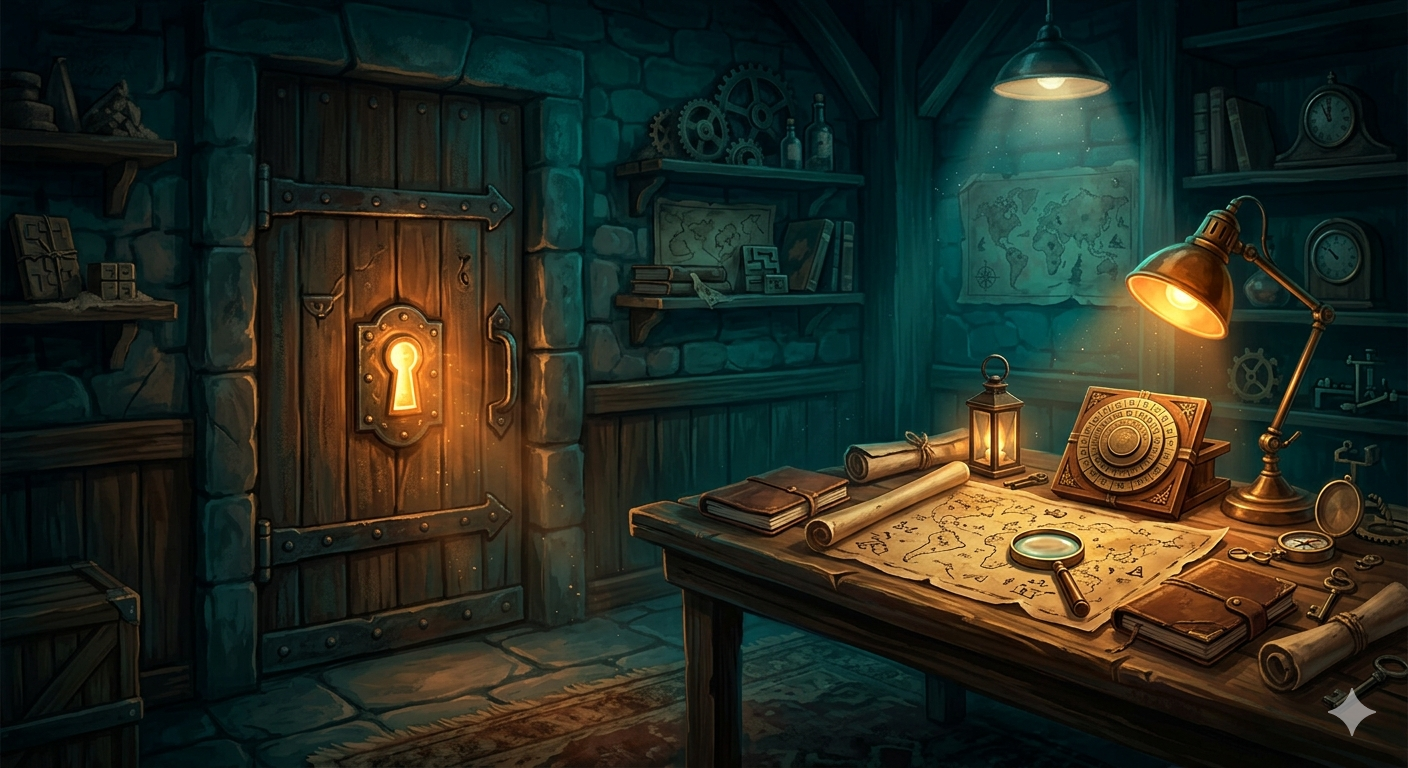
Escape rooms — digital and physical. Reward systematic observation over inspired guessing. The players who finish fastest aren't necessarily the smartest; they're the most organised. This guide covers the frameworks that work across game types: how to catalogue clues, which puzzle types tend to chain together, and why over-communication beats lone-wolf problem-solving every time.
The Real Reason People Get Stuck
Most escape room failures come down to one of three things: you found a clue but didn't register it as a clue, you correctly solved a puzzle but applied the answer to the wrong lock, or you spent fifteen minutes on a puzzle that wasn't meant to be solved yet because a prerequisite clue was still hidden somewhere else in the room.
None of these are intelligence failures. They're process failures. The players and teams that consistently escape, in games like Rooms & Exits or in physical rooms. Do it through repeatable frameworks, not flashes of brilliance.
Framework 1: Sweep Before You Solve
When you enter a new area or load a new room, resist the urge to immediately interact with anything. Spend the first 60–90 seconds doing a complete visual sweep. In physical rooms, this means checking high and low — near the floor, behind furniture, inside containers, underneath objects. In digital games like Rooms & Exits, it means tapping every region of the screen methodically before focusing on any single element.
Make a mental (or physical) note of:
- Every lock type you can see and how many inputs it needs
- Every piece of paper, symbol, or notation visible
- Anything that looks like it has been deliberately placed rather than being ambient decoration
- Containers that are closed but accessible
The reason for this upfront sweep is that escape room designers frequently plant clues in locations you'll stop looking once you're focused on a puzzle. The time to notice the symbol scratched into the base of a lamp is before you're staring at a four-digit keypad.
Framework 2: Match Clues to Locks Explicitly
Every clue in an escape room is either a direct answer to a lock, a step in a chain leading to one, or a red herring (rare in well-designed rooms). Your job is to figure out which.
The most useful habit: when you find a clue, immediately ask "what in this room could this answer?" Try to match it before moving on. If you find a sequence of four coloured symbols, scan the room for a four-input colour lock. If you can't find one, file it mentally under "apply this later" rather than trying to use it on something it clearly doesn't fit.
In Rooms & Exits specifically, the puzzle chains tend to be tighter than in many other escape room games. A clue found in one drawer almost always feeds a puzzle within the same room before unlocking access to new areas. See the Rooms & Exits walkthrough for room-by-room breakdowns when you hit a wall.
The Common Puzzle Types and How to Read Them
Directional / Arrow Puzzles
These give you a sequence of arrows or directions and require either a physical direction combination lock or a grid-based input. Key insight: the orientation of the arrows usually matters more than their arrangement. Check whether the puzzle is telling you which direction to enter on a keypad, or which cells in a grid to select.
Symbol Substitution
You'll find an image that maps symbols to letters or numbers, and a separate lock that uses those symbols. Classic escape room puzzle. The failure mode here is misidentifying the direction of the mapping: are you converting symbols to letters, or letters to symbols? Always re-read the cipher source once you think you have the answer.
Sequential Colour or Shape Codes
You find coloured objects in specific locations, and a lock that takes a colour sequence. Designers often hide the sequence in the order you discover things: the colour of the first object you find when entering the room, the second, and so on. If you're struggling, backtrack and think about the intended discovery order.
Hidden Text / UV-Dependent Clues (Digital)
Many digital escape rooms simulate hidden clues that only become visible when you "apply" a found item (a torch, a UV lamp, a magnifying glass) to a surface. In games like Rooms & Exits, this manifests as combining an inventory item with a scene element. Always try your inventory on anything that looks blank or suspiciously plain.
Math and Logic Puzzles
Unlike Brain Test, escape room math puzzles usually have a genuine correct mathematical answer. The trick is that the numbers you need are scattered around the room rather than being on the same wall as the puzzle. If you see a three-digit combination lock and the room has three framed pictures with notable numbers, those numbers are almost certainly the combination, in some order. Try a few common orderings (largest-to-smallest, order of discovery, order they appear left-to-right on a wall) before looking for hidden instructions about sequence.
For Teams: Communication Over Competition
In multi-player escape rooms, the teams that struggle most are the ones where everyone solves independently and then fails to share. Call out clues loudly and immediately. "I found a three-digit number on a matchbook" — without waiting to understand it first. Someone else may instantly know which lock it opens.
Designate someone to manage the "unsolved" pile: items and clues that haven't yet been connected to a puzzle. Review this pile every few minutes. The solution to a puzzle you've been stuck on for ten minutes is often a clue that's been sitting in that pile the whole time.
When to Ask for a Hint
Physical rooms give you a finite number of hints; use them strategically. A good rule of thumb: if a team of intelligent people has been stuck on the same thing for more than eight minutes, a hint is the right call. The goal is to enjoy the full room, not to prove you can grind through one puzzle.
In solo digital games, hints are usually unlimited but cost in-game currency or require watching an ad. The same eight-minute rule applies. After that point, a hint is more valuable than the satisfaction of eventually figuring it out cold.
Frequently Asked Questions
Is Rooms & Exits good for beginners?
Yes, Rooms & Exits has a graduated difficulty system that starts with genuinely accessible rooms before introducing complex multi-step chains. It's one of the better mobile escape room games for players who are new to the genre because the puzzle logic is consistent and fair.
How many rooms does Rooms & Exits have?
The game has grown to well over 50 distinct rooms across multiple chapters, with additional content released through seasonal updates. The Rooms & Exits hub tracks available rooms with level-by-level guides.
What's the hardest type of escape room puzzle?
Subjectively, multi-step logic chains where you need to combine three or four independent clues in the right order cause the most grief. These aren't hard once you know they exist. They're hard because most players don't realise they need to combine clues rather than apply them individually. Once you develop the habit of asking "does this clue need to be combined with something else?", these puzzles become satisfying rather than frustrating.
Do escape room strategies translate to other puzzle games?
Many of them do, especially the inventory-management mindset and systematic sweep approach. The core principle — observe everything before acting, match clues to locks explicitly. Applies broadly across puzzle game genres. It's less useful for games like Brain Test that are deliberately trying to subvert systematic thinking, but for any puzzle with consistent internal logic, these frameworks help.