
Most mobile puzzle games for adults fail the same way: they teach you one mechanic and repeat it 200 times with slightly higher numbers. Genuinely challenging puzzle games make you think differently each level — combining brain teasers, escape room logic, word games, and multi-step reasoning. This guide breaks down what separates hard-but-fair from hard-but-frustrating, and recommends specific games in each category worth your time.
Why Most Mobile Puzzle Games Feel Too Easy
The mobile game market has a retention problem masquerading as a difficulty problem. Studios tune puzzle difficulty around keeping players in a comfortable zone. Challenged just enough to feel progress, never challenged enough to consider quitting. The result is games that feel engaging for the first hour and mechanical by the third.
There are a few common patterns that produce this:
- Single-mechanic scaling, the game introduces one rule on level 1 and just adds more pieces or a tighter time limit by level 50
- Hint dependency loops. Hints are cheap or free, so the difficulty curve is irrelevant; you skip anything hard
- Pattern recognition over reasoning. Levels are solvable by noticing visual similarity to a previous level rather than fresh deduction
- Dopamine over thinking. Fast animations, constant rewards, and satisfying sound effects substitute for the genuine satisfaction of solving something difficult
The puzzle games that hold up for adult players break these patterns. They introduce new mechanics regularly, make hints costly or scarce, reward reasoning over memory, and let you sit with a hard problem instead of rushing you through it.
What Makes a Puzzle Game Challenging vs Frustrating
There is a real distinction here, and it matters when picking games. A challenging puzzle is hard because the solution requires a genuine insight, something you could not have seen without thinking carefully. A frustrating puzzle is hard because of hidden information, unfair rules, or pixel-hunting in a tiny interface.
Characteristics of fair difficulty
- All information needed to solve the puzzle is visible or discoverable in the current state
- The rules are consistent. A mechanic that worked one way on level 10 works the same way on level 40
- The "aha" moment feels earned rather than arbitrary
- When you fail, you can identify what you missed without needing an explanation
Signs of unfair difficulty
- Solutions require guessing a developer's specific intended interpretation
- Important clues are hidden by the interface rather than the puzzle design
- Mechanics change without warning between levels
- The only way to discover the solution rule is by failing multiple times with no feedback
The best mobile puzzle games for adults stay firmly in the first category. Once you know what to look for, it is fairly easy to tell within the first five levels whether a game is being difficult honestly or just being obtuse.
Category 1: Brain Teasers That Subvert Expectations
Brain teaser games specifically designed for adults work by weaponising your own assumptions. The puzzle looks like it should be solved one way; the actual solution requires ignoring the obvious approach entirely.
Brain Test is the reference point in this category. The game's central mechanic is lateral thinking: questions are phrased in ways that suggest a logical mathematical or visual answer, and the correct solution is almost never the one you first reach for. In one level you might need to count objects that seem clearly countable, only to discover you were counting the wrong things. In another, the interface itself becomes part of the puzzle.
What keeps Brain Test genuinely challenging across its full run is that each level introduces a distinct trick rather than scaling a single idea. You cannot develop a reliable solving strategy because the game actively punishes systematic thinking. The players who perform best are those who are willing to question their own assumptions about what a puzzle is asking.
What to look for in brain teaser games
- New trick each level, not incremental difficulty scaling
- Questions that have clear wrong answers that feel right at first
- Interaction with the device itself (tilting, screenshot, adjusting brightness) as part of the puzzle
- A hint system that gives directional clues rather than full solutions
Category 2: Escape Room Games with Real Depth
Mobile escape room games occupy a narrow band of quality. Most are either too shallow. A series of disconnected mini-puzzles with no logical environment, or too opaque, requiring you to tap every pixel hoping for an interaction. The good ones build rooms with internal logic: clues connect to each other, the environment tells a story, and solutions feel coherent once you find them.
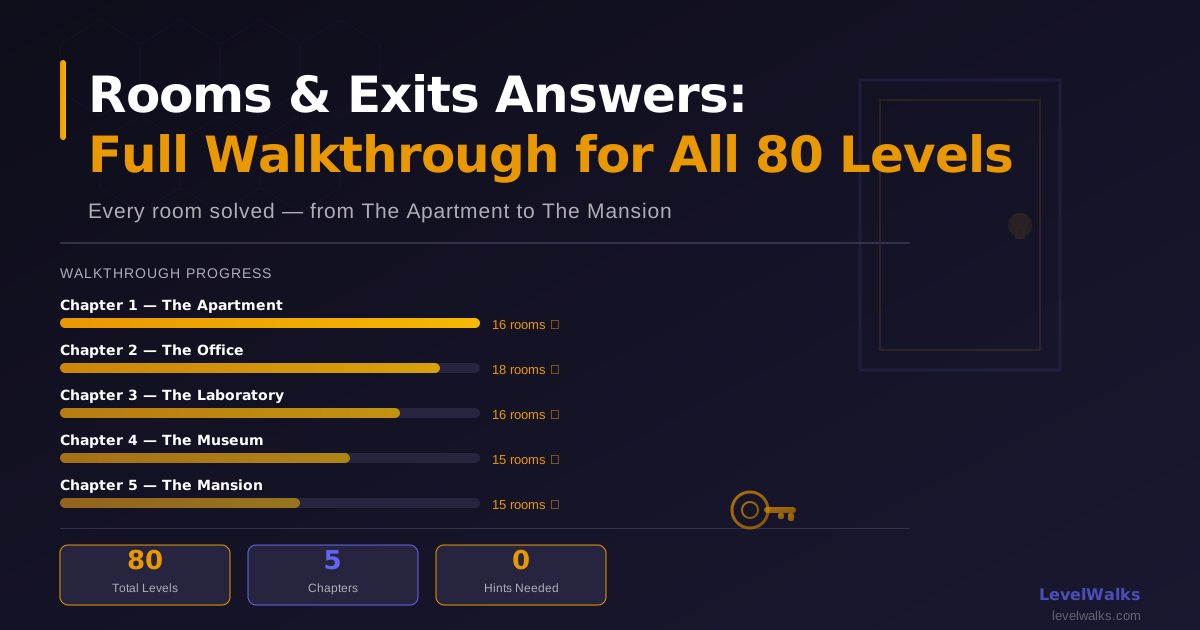
Rooms and Exits is consistently cited as one of the better options for adults who want a mobile escape room game that respects their intelligence. The puzzle chains are multi-step but fair. You rarely need information you haven't found yet, and the solutions reward observational thinking over random tapping.
What makes escape room games challenging for adults specifically is the inventory management dimension. You are not just solving puzzles in isolation. You are tracking which items you have found, which puzzles remain open, and which clues might connect to which locks. This working-memory load adds a layer that purely visual puzzle games do not have.
The depth markers in good escape room games
- Rooms have an internal narrative. The environment explains why the puzzles are there
- Multi-step chains where solving puzzle A reveals the clue needed for puzzle B
- Inventory items that combine with each other or with the environment
- Puzzle variety within a single room (not just colour codes repeated in different colours)
Category 3: Word Puzzle Games That Actually Make You Think
Word puzzle games span an enormous range of cognitive demand. Wordle is enjoyable but primarily tests vocabulary breadth. Crosswords test recall. The games that challenge puzzle games that make you think at a deeper level are the ones that require combinatorial reasoning, finding words under constraints that mean simple vocabulary is not enough.
Word Cookies is a strong example of a word game with genuine challenge built in. The format. Find all possible words within a set of letters — creates a search space that grows non-linearly with the letter count. Finding the obvious six-letter answer is straightforward; finding the obscure three-letter words that complete the set requires both vocabulary and a willingness to exhaust combinations systematically.
The difficulty in Word Cookies scales naturally because the constraint space tightens as you progress. Early levels have letter sets that produce a manageable number of valid words. Later levels have letter combinations that produce dozens of valid words, most of which you'll miss on the first pass. The cognitive demand is real: you need to hold the available letters in working memory, generate candidates, and filter them against the constraint that they must use only those letters.
What makes word puzzle games stand out beyond basic vocabulary tests
- Combinatorial constraints (must use these letters, no others) rather than free-form answers
- Completion requirements rather than just "find some words". You need all of them
- Progressive difficulty based on letter frequency and word obscurity, not just word length
- Timed modes that add pressure without making the core puzzle arbitrary
Category 4: Logic and Deduction Games
Pure logic games, spatial puzzles, deduction grids, path-finding with constraints. Represent the category where adult players often have the most unmet demand. These games exist in abundance on PC and console but are relatively sparse as well-executed mobile experiences.
The defining characteristic is that logic games have objectively correct solutions derivable through pure reasoning. There is no lateral thinking trick, no vocabulary requirement, no observational insight needed. Just systematic deduction applied to a defined rule set. This makes them uniquely satisfying for players who want to know definitively that they solved a puzzle correctly rather than eventually stumbling on the answer.
Spatial reasoning puzzles
These include sliding block puzzles, pipe-connection games, and grid-fill challenges. The appeal is that the state space is fully visible. You can see every piece and every empty space, so any failure is a failure of reasoning, not information. Well-designed spatial puzzles have a single solution that becomes obvious in retrospect but is non-obvious at first glance.
Deduction and constraint satisfaction
Games in the tradition of Sudoku, Picross, and logic grid puzzles require applying constraints repeatedly until the solution collapses into a single possibility. These scale predictably in difficulty based on the size of the grid and the density of initial constraints, making them reliable for players who want to calibrate their challenge level precisely.
Casual vs deep logic games
The gap between mobile logic games that feel light versus those that feel substantial is largely about state depth. How many cells or variables are in play at once. A 4×4 Sudoku is solvable almost mechanically; a 9×9 Sudoku with a hard configuration requires genuinely holding multiple constraint chains in mind simultaneously. When picking logic games, look at the maximum configuration size to gauge the ceiling of difficulty.
How to Build a Puzzle Game Rotation That Stays Interesting
One reason adults find mobile puzzle games stop feeling challenging is that they play one game to completion and then face a cold-start problem finding the next. A better approach is to maintain a rotation across the different categories.
A practical starting rotation for adults who want consistently challenging puzzle games mobile:
- Brain teaser (daily), a few levels of Brain Test for lateral thinking warm-up
- Escape room (weekly session). Rooms and Exits works best in focused 30-minute blocks rather than dip-in-and-out play
- Word game (commute filler), Word Cookies is ideal for short sessions because individual levels are completable in 3–8 minutes
- Logic game (weekend deep work). Sudoku, Picross, or a spatial puzzle game that requires a distraction-free environment
The rotation works because different puzzle categories use different cognitive tools. Lateral thinking, working memory, vocabulary + combinatorics, and pure deduction are all distinct skills. Playing across categories keeps you from optimising too narrowly and means you're genuinely thinking differently each time you pick up your phone.
A Note on Difficulty Progression vs Difficulty Spikes
The best challenging puzzle games mobile handle difficulty as a gradual ramp, not a series of spikes. A difficulty spike. A level that is dramatically harder than everything before it with no clear reason. Usually indicates poor playtest coverage rather than intentional design. It is not more satisfying than steady progression; it is just more likely to make you quit.
When evaluating a new puzzle game, pay attention to whether the first hard level you hit feels connected to the mechanics you've already learned or disconnected from them. If a difficult level requires a mechanic you haven't seen demonstrated, that's a design failure. If it requires you to apply mechanics you know in a more demanding combination, that's good difficulty design.
Frequently Asked Questions
What mobile puzzle games are actually challenging for adults?
The strongest options depend on which type of challenge you want. For lateral thinking that subverts your assumptions, Brain Test is consistently recommended. For escape room logic with multi-step clue chains, Rooms and Exits holds up well across its full run. For word games that require combinatorial thinking rather than just vocabulary, Word Cookies is a strong choice. For pure logic and deduction, well-configured Sudoku or Picross-style games provide reliable difficulty scaling.
How do I know if a puzzle game is challenging or just frustrating?
A fair puzzle gives you all the information you need to solve it within the current state, you're just not seeing how the pieces connect yet. A frustrating puzzle withholds information, changes rules without explaining them, or relies on guessing the designer's specific intended interpretation. The practical test: when you look at a solution after failing, does it feel like "I should have seen that" or "there's no way I could have known that"? The first is fair challenge; the second is poor design.
Are mobile puzzle games good for brain training?
The evidence for puzzle games producing transferable cognitive improvements is mixed. Most studies show that you get better at the specific game you're playing rather than at general reasoning. That said, games that require you to hold multiple constraints in working memory simultaneously (escape room inventory management, combinatorial word games, multi-step Sudoku deductions) do exercise cognitive resources that are genuinely useful. The value is less about measurable IQ gains and more about the sustained attention and deliberate thinking that hard puzzles require.
What's the difference between puzzle games for adults vs puzzle games for kids?
Adult-oriented puzzle games assume prior familiarity with puzzle conventions and build on top of them — they can use more complex rule sets, require larger working memory, and reward knowledge of language or logic patterns that kids haven't accumulated yet. They also tend to have slower hint systems (or paid hints) that require you to genuinely attempt the puzzle before getting help. The distinction isn't binary: many puzzle games marketed to general audiences are genuinely demanding for adults, and the category labels are a loose guide rather than a guarantee of difficulty level.