I'm Jim Liu. I run LevelWalks from Sydney and I've been playing puzzle games daily for years. The Archives of Trevosa is a free browser deduction game released April 2026 — you untangle a royal family tree across 30 people and 7 generations by reading documents and translating a made-up language. No combat, no timer, just detective work. The trick that unlocks everything: start by translating relationship words (the Trevosan equivalents of mother/father/aunt) before you try to pin any names. Once you've got 3 family members confirmed, the game locks them in and the rest cascades. This guide covers the core mechanic, the language-decoding system, and six tips I wish I had on hour one.
What Is The Archives of Trevosa?
The Archives of Trevosa is a free browser detective game released in April 2026 by jamwitch, a two-person indie team. The premise: a fictional kingdom called Trevosa left behind fragments of royal records — decrees, letters, journals — and you have to piece together a 30-person family tree spanning seven generations. Every family member needs a confirmed name and title before you're done.
It's inspired heavily by The Roottrees Are Dead, which has its own cult following among thinky-game players. The added twist in The Archives of Trevosa is a constructed language: Trevosan documents use their own cultural vocabulary for family relationships, ranks, and events. You're not just finding facts — you're also translating as you go.
The game runs entirely in browser, costs nothing, and takes most players between 3 and 6 hours depending on how much they fight the language system early on. Thinky Games featured it and Kotaku covered it within a week of release, so it caught attention fast.
How the Search Mechanic Works
The Archives of Trevosa gives you a document viewer on one side and a family tree on the other. The core loop is simple in theory:
- Read a document. It mentions a person by name or title.
- Click any word in the document to search the archive for other documents containing that word.
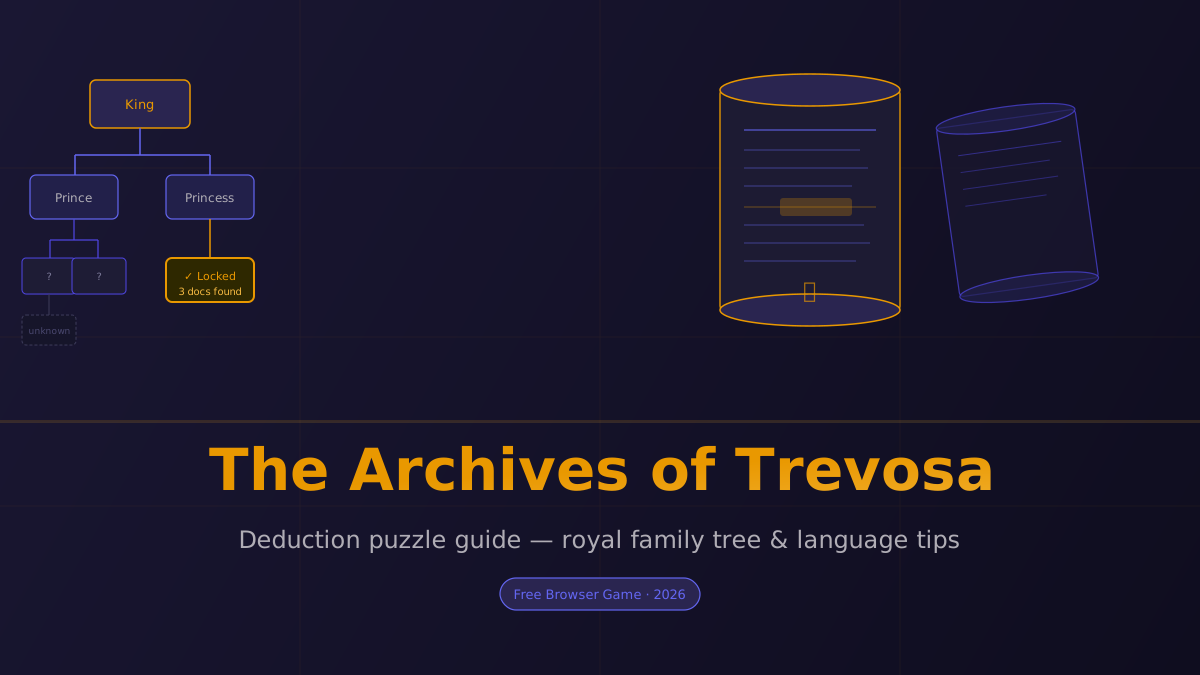
- The first three documents mentioning a person confirm enough to lock in their identity.
- Once locked, their slot in the family tree turns confirmed and you can move on.
The click-to-search mechanic is satisfying once you trust it. Click a name, see which other documents reference it, follow the chain. The danger is going too wide too fast — you end up with 15 half-resolved leads and no confirmed nodes.
One mechanical detail that tripped me up: hyphenated words don't fully search when you click them. If a document says "cynai-til" and you click it, you'll only search "cynai" or "til" depending on which half you clicked. Hyphenated terms need to be typed manually into the Search tab. Several of the most important relational titles are hyphenated, so this matters early.
Cracking the Trevosan Language
This is where The Archives of Trevosa separates itself from other family-tree puzzles. The documents aren't in plain English for relationship terms. "Mother" isn't "mother" — it's whatever Trevosan word the royal scribes used, and you have to figure that out from context before names start making sense.
My approach, after an embarrassingly long first session of ignoring this:
- Read for structure, not names first. A letter that says "X [unknown word] Y attended the coronation" tells you X and Y have some relationship before you know either name.
- Cross-reference relationship words. If the same Trevosan word appears in three documents connecting a younger person to an older person of the same line, it's probably a parent-child term.
- Look at the tree shape for clues. The family tree already shows you the generational structure — blank slots in the same generation are siblings or cousins, blank slots above/below are parents/children. Use that shape to validate your language guesses.
The language layer is genuinely elegant once it clicks. It adds maybe 30-40 minutes of confusion but then becomes a second puzzle running in parallel with the genealogy one. Some players in the itch.io comments called it the best part. I'd agree, though I didn't feel that way at hour one.
Six Tips That Actually Help
1. Start with titles, not names
The family tree shows each empty slot with a title placeholder (like "cynai-til" or similar rank indicators). Search those title terms first before you touch any proper names. Titles are consistent across multiple documents and give you the relational skeleton before personalities fill it in.
2. Enable undiscovered document hints immediately
Under the Filter section of the archive there's an option to show how many undiscovered documents contain a given search term. Turn this on from the start. It tells you when a word is worth pursuing (3 undiscovered docs) vs. exhausted (0 new docs). Without this I was re-searching terms I'd already pulled everything from.
3. Get 3 confirmed before spreading
Lock in your first three family members before chasing any other leads. The confirmed lock-in mechanic removes those slots from ambiguity and often clarifies adjacent relationships immediately. Players who spread too wide before confirming anything tend to build circular theories that all seem equally valid.
4. Use the tree shape to falsify guesses
If your current theory would put two people in the same generation slot, or create a parent who's younger than their child, the tree won't accept it. Don't wait to get stuck — actively check your working theory against the tree's structure constraints as you build it. The game won't let you confirm an impossibility, but knowing why a guess fails is faster than realising it fails.
5. Type hyphenated terms manually
Already covered in the mechanics section, but worth repeating: clicking a hyphenated word only searches half of it. Several critical rank and relationship titles in The Archives of Trevosa are hyphenated. If a search returns almost nothing and you think it should return more, switch to the Search tab and type the full hyphenated term.
6. Step back when you're going in circles
I hit a wall about halfway through where every new document seemed to contradict something I'd already concluded. Stepping away for 20 minutes and coming back cold let me spot that I'd misidentified a relationship word and propagated that error across four theories. The game's not hard — it's a logic puzzle, and logic puzzles reward fresh eyes more than persistence.
What to Do When You're Completely Stuck
A few specific situations and what helped:
"I've read every document and still can't confirm anyone." — Go back to relationship vocabulary. You're probably trying to confirm identities before you've decoded the language well enough. Pick the most common non-name word in the documents and search it exhaustively until you know what it means.
"I've confirmed several people but the rest won't resolve." — Search every confirmed person's name again from scratch. Documents that mentioned them might now be reinterpretable with your new knowledge. The archive doesn't hide information from you after lock-in; you just have new vocabulary to read old documents with.
"Two people seem interchangeable and I can't tell them apart." — Check the undiscovered document count for both names. One will usually have more unread references. Follow the richer trail first and the other person often becomes obvious by elimination.
The Archives of Trevosa has no hint system beyond the undiscovered document counter. That's intentional — the game is built around giving you everything you need in the archive itself. If it feels impossible, the answer is in a document you've already seen but misread.
Frequently Asked Questions
Is The Archives of Trevosa free?
Yes. The Archives of Trevosa is completely free to play in your browser at jamwitch.itch.io/trevosa. There's no download required and no paywall. The developers accept optional donations but the full game is accessible without paying anything.
How long does The Archives of Trevosa take to complete?
Most players finish in 3 to 6 hours. The range is wide because the Trevosan language system can either click in the first hour or take most of a session to crack. If you go in knowing to translate relationship terms before chasing names, you're probably looking at 3 to 4 hours.
Do I need to know The Roottrees Are Dead to play?
No. The Archives of Trevosa is standalone and the game explains its own mechanics. Familiarity with Roottrees helps you understand the genre's logic-puzzle approach, but it's not a prerequisite. Players new to narrative deduction games report finishing it fine.
Can I save progress in The Archives of Trevosa?
The browser version saves progress in your local browser storage. As long as you don't clear your browser cache or use a different browser/device, your progress persists between sessions. If you want to be safe, complete the game in one browser without clearing site data.
Is there a walkthrough with full solutions?
As of early May 2026, there's no published full solution online. The game is new enough that the community is still solving it. The itch.io comments have hints from players and the developers themselves respond to questions there. For most stuck points, the undiscovered document hint toggle solves the problem without giving answers away.