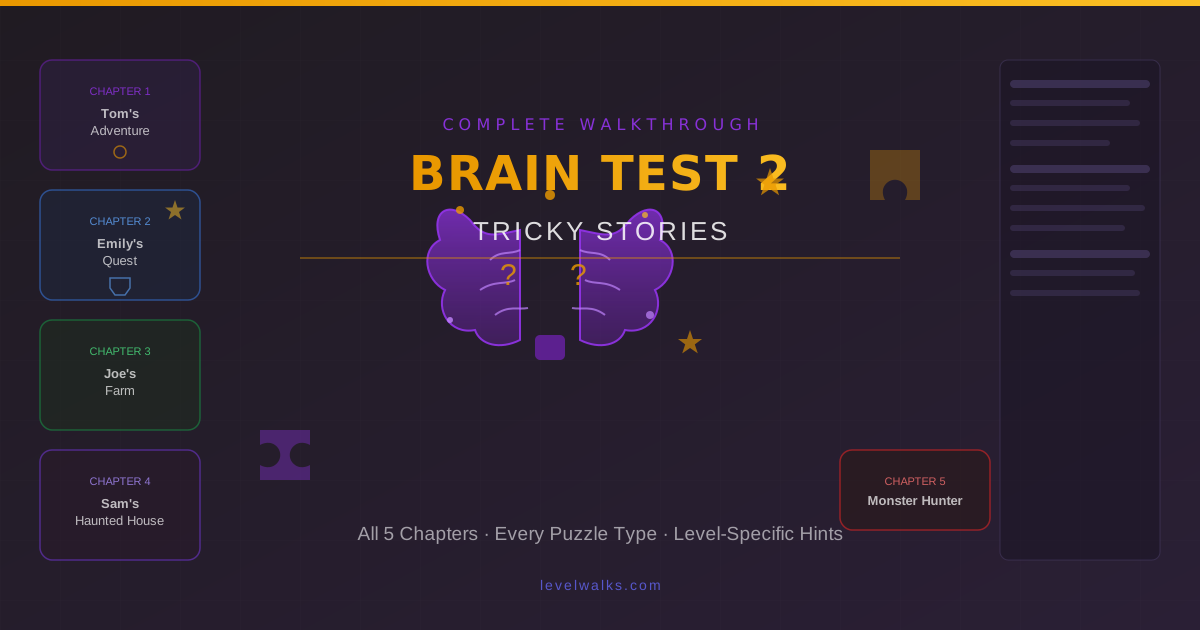
Brain Test 2: Tricky Stories is built around five story chapters — Tom, Emily, Joe, Sam, and Monster Hunter. Each with 20 connected levels. Unlike the original Brain Test, puzzles here carry narrative context: a farmer's puzzle has a farm-logic solution, a scientist's puzzle rewards systematic thinking. This walkthrough gives chapter-level strategy plus targeted hints for the levels that consistently stump players, without removing every surprise.
What Makes Brain Test 2 Different
The original Brain Test was a collection of 300+ standalone puzzles with no connecting thread. Brain Test 2 replaces that structure with story chapters. Each chapter follows a specific character through 20 levels, and the character's personality is a genuine hint system.
Here is what actually changes about the puzzle logic:
- Context narrows the solution space. When Joe the farmer needs to solve something, the answer involves farm tools, animals, or weather. Not chemistry or technology. Use the chapter setting as your first filter.
- Multi-step solutions are the norm. Most levels in Brain Test 1 required one key interaction. Brain Test 2 regularly needs two or three sequential actions. If your first move does something but doesn't finish the level, you are on the right track.
- Items persist within a chapter. Objects introduced in early levels sometimes reappear as tools in later ones. If you remember where something was, it may save you ten minutes of confusion later.
- Failing deliberately teaches you. A handful of levels only reveal their path after you fail in a specific way. The failure animation contains a clue. Do not restart instantly, watch the whole sequence.
Tom's Adventure. Chapter Strategy
Tom is the introductory character: clumsy, well-meaning, perpetually behind schedule. His chapter is the gentlest difficulty ramp in the game and teaches you the core interaction types you will use everywhere else.
Chapter mindset: Tom's problems are mundane, late for work, car trouble, stuck in traffic. The solutions always bypass the expected solution. The car won't start? Don't fix the engine; use something else entirely. He's stuck in traffic? You probably don't need the traffic light.
Levels Most Players Get Stuck On
Level 3. Tom's Car Won't Start
The hood opens when you tap it, which is the right first step. The battery you need is not on screen by default. Drag the toolbox on the right side of the scene. The battery is behind it, partially clipped by the edge. Drag it out and drop it into the open engine bay. The car starts automatically.
Level 11. Tom Needs to Cross the River
Two interactions required. First, drag the two clouds together above the scene to create rain, this raises the river level. Then drag the floating log to Tom's side of the bank. He steps onto it as a raft. Players who try the bridge first (it's broken) or try to swim Tom across waste time here.
Level 15. The Treasure Map
The map's X marks a location, but the X is wrong until you flip the map. Physically rotate your device upside down — the map orientation flips with it. Now the X marks a different spot on the ground. Tap that spot. The game will place the shovel in Tom's hands automatically.
Level 20. Tom Gets Home
Systematically check everything: under the mat (nothing), in the flower pot (nothing), behind the bush (nothing). The key is inside Tom's shoe. Tap his shoe to remove it. Key drops out. Drag key to padlock. This is the chapter's closing lesson, always check character inventory items last.
Emily's Quest. Chapter Strategy
Emily is the scientist. Her chapter rewards systematic thinking over creative leaps. Solutions tend to follow an internal logic: mix the right chemicals, follow the formula, fix the equipment properly. If Tom's chapter is about ignoring the obvious, Emily's is about following an unconventional procedure exactly.
Chapter mindset: Think like a lab technician. When something doesn't work, diagnose why rather than trying random interactions. The robot isn't activating because of a specific mechanical reason. Find and fix that reason rather than pressing buttons.
Levels Most Players Get Stuck On
Level 4. The Formula Is Too Small
Use a two-finger pinch-zoom gesture directly on the blackboard. This is one of the rare levels requiring a multi-touch gesture. If you are on an emulator, try scroll-zooming with a mouse over the blackboard. The formula revealed here tells you the correct mixing order for the next level, write it down.
Level 12. Emily's Robot
The on/off switch does nothing because the batteries are installed backwards. Tap the battery compartment on the robot's back, it opens. Drag both batteries out, flip them in your mind, re-insert them the other way. The orientation switch is the only change needed. Robot activates and carries the equipment on its own.
Level 16. The Chemical Reaction
The level shows containers labeled H, H, and O. Drag both H containers onto the O container. You are literally making H₂O. The water overflows into a basin below, revealing a key. Most players overthink this, the chemistry pun is the solution, executed directly.
Joe's Farm. Chapter Strategy
Joe's chapter has the most charming visual design in the game and also some genuinely funny solutions. The farm setting means solutions almost always involve the natural world: animals, weather, crops, or farm equipment. Technological or science-based solutions will never be right here.
Chapter mindset: Think like a practical farmer who improvises. The hose is broken, but water has to come from somewhere. The cow is unhappy, but a farmer knows how to help an animal. Work with the environment, not against it.
Levels Most Players Get Stuck On
Level 9. Water the Crops
The hose is broken, the well is dry. There is a rain cloud at the very left edge of the screen, barely visible. Drag it all the way over the crops, then tap it. It rains, the crops grow. The cloud is positioned at the extreme screen boundary. This is a common hiding spot across all Brain Test 2 chapters.
Level 14, The Cow Won't Give Milk
The cow looks miserable. Drag the radio from the barn window and place it near the cow. Tap the radio to play music. The cow starts moving happily and milk fills the bucket automatically. The solution is based on the folk claim that cows produce more milk when they hear music. The game takes it literally.
Level 18 — Harvest the Pumpkins
There are too many pumpkins to pick individually before the timer expires. The tractor is the answer, but it needs fuel first. The gas can is behind the barn. Drag it out and drop it on the tractor's fuel cap. Then drag Joe onto the tractor seat, and drag the tractor from left to right across the field. It harvests everything in one pass.
Sam's Haunted House, Chapter Strategy
Sam's chapter is the darkest visually and the most creative conceptually. The haunted house setting means solutions often work on the logic of folklore and ghost stories. A ghost in a mirror disappears when the mirror is covered, not when you fight the ghost. The game uses genre conventions as its hint system.
Chapter mindset: Think in terms of how haunted house rules work in movies and folklore, not real-world logic. Mirrors, light, sound, and superstitions are all puzzle mechanics here.
Levels Most Players Get Stuck On
Level 6. Ghost in the Mirror
The ghost only exists in the reflection, so blocking the mirror removes it. Drag the curtain from the window across the mirror to cover it. The ghost is gone. Fighting the ghost, throwing items at the mirror, or trying to move the mirror all fail. The logic is folklore-based, not physical.
Level 10, The Skeleton's Riddle
The riddle: "What has hands but can't clap?" The answer is a clock. Drag the clock off the wall and drop it onto the skeleton. The skeleton accepts the answer and the door unlocks. Trying to drag Sam's hands or any character's limbs causes the skeleton to laugh and reset the level. Watch for this trap.
Level 15, The Dark Basement
Raise your actual device screen brightness to maximum. The game detects the brightness value and illuminates the scene proportionally. If that doesn't work on your device, look for a faint candle glow on the stairway. Tap and hold it to light the candle manually. Either method reveals the room.
Level 20, Escape the Looping House
Every door in the house leads back to the same room. The haunted house has looped the exits as a trap. Stop using doors. Look for a cracked section of wall on the right side of the room. Tap the crack three times in quick succession. The wall breaks and Sam escapes through the gap. This is the chapter's final lesson: sometimes the stated exits are wrong.
Monster Hunter. Chapter Strategy
The Monster Hunter chapter is considered the hardest in the base game by most players. The hunter character tracks and catches creatures, and the puzzles involve deception, misdirection, and multi-step trapping sequences. Some levels have tight timing windows that require quick execution after you figure out the solution.
Chapter mindset: Hunting means patience, observation, and indirect approaches. You rarely fight monsters directly. You lure them, trick them, or remove the conditions that protect them.
Levels Most Players Get Stuck On
Level 3. Track the Monster
The footprints lead off screen to the right, which is a false trail. Look at the prints carefully: they get smaller as they approach the right edge, meaning the monster walked toward you (perspective). The monster is hiding directly behind the hunter character. Tap the space behind the hunter to find it.
Level 8, Catch the Flying Monster
The net is too small to catch it mid-air. Drag the cheese from the hunter's backpack and drop it on the ground. The monster lands to eat it. You now have about two seconds: tap the net to throw it over the monster. This is one of the few timed levels in the game. If you miss the window, the monster takes the cheese and flies away. Drag more cheese from the backpack for another attempt.
Level 13 — The Invisible Monster
You can hear it but see nothing. Drag the flour bag from the bottom of the screen to the center of the room and tap it to burst it. The flour cloud settles and reveals the monster's outline in white powder. Tap the outlined shape to catch it. The flour trick is a classic "reveal the invisible" mechanic. Expect it to reappear in later chapters.
Level 17, Monster in the Lake
Look for a small circular plug near the lake bed. It blends with the rocks and is easy to miss. Drag the plug to drain the lake. The water level drops and the monster is exposed on the dry lakebed. Tap the net to catch it. The entire level depends on spotting that plug, which is deliberately camouflaged.
Level 20. The Final Monster (Multi-Step)
This is the chapter's timed finale. Three steps must happen in sequence within roughly five seconds:
- Drag the mirror to reflect the monster's fire breath back at it. The monster staggers.
- While stunned, drag the rope around its legs.
- Tap the cage to drop it over the monster.
If you miss any step's timing window, the monster recovers and the level resets to the start. Rehearse the sequence mentally before executing. Once you start the mirror reflection, you are committed.
Universal Tips Across All Chapters
| Situation | What to Try |
|---|---|
| Nothing seems interactive | Drag your finger slowly along all four screen edges, objects hide at boundaries |
| One action does something but doesn't finish the level | You found Step 1. Look for what changed and interact with the new state |
| Physical device won't respond as expected | Try: rotate device, shake it, increase screen brightness, cover light sensor |
| Stuck for more than 3 minutes | Use the first built-in hint only (nudge) before going to a full walkthrough |
| Timed level. Know the solution but failing execution | Pre-plan which finger goes where before you start the triggering action |
| Solution involves a character's body part | Tap the character multiple times, body parts (shoes, hands, hair) often detach |
Using the Chapter Theme as a Hint System
This is the single most underused strategy in Brain Test 2. When you are stuck, ask: what would make sense for this character's world? A scientist's problem has a science solution. A farmer's problem has a nature solution. A haunted house problem has a folklore solution. Eliminating solutions that don't fit the chapter's internal logic cuts the search space roughly in half before you start experimenting.
For more on the lateral thinking approach that Brain Test 2 builds on, the Brain Test 1 complete guide covers the five core puzzle categories in depth. They all appear in Brain Test 2 as well.
Frequently Asked Questions
Is Brain Test 2 harder than Brain Test 1?
On average, yes. The multi-step puzzles and story context add layers that the original lacked. However, difficulty resets at the start of each chapter, so no single stretch of levels is as unbroken as Brain Test 1's 300+ level sequence. The hardest individual puzzles in both games are comparable in difficulty.
Do I need to play Brain Test 1 first?
No, Brain Test 2 is standalone and teaches its own mechanics. That said, players who have completed the original will find the first few levels of each Brain Test 2 chapter noticeably easier, since the lateral thinking habit is already trained. See the Brain Test 1 guide if you want that grounding.
How many chapters are in Brain Test 2?
The game launched with five core chapters (Tom, Emily, Joe, Sam, Monster Hunter) and Unico Studio has added more through updates. As of early 2026, there are over ten chapters including seasonal content. The five core chapters are the most played and are permanently available.
Can I replay completed chapters?
Yes. The chapter select screen lets you replay any finished chapter without losing your completion status. Replaying is useful if you used hints and want to figure out the real solutions retroactively.
What is the hardest chapter in Brain Test 2?
Most players and community discussion point to the Monster Hunter chapter as the hardest, primarily because of the timed multi-step sequences in levels 8 and 20. The Haunted House chapter comes second due to the device-interaction levels. Tom's chapter is generally considered the most approachable.
Are Brain Test 2 answers the same on iOS and Android?
For the vast majority of levels, yes. A small number of device-interaction puzzles (brightness detection, multi-touch, shake gestures) may behave differently depending on your OS version and hardware. Core puzzle logic and solutions are identical across platforms.