
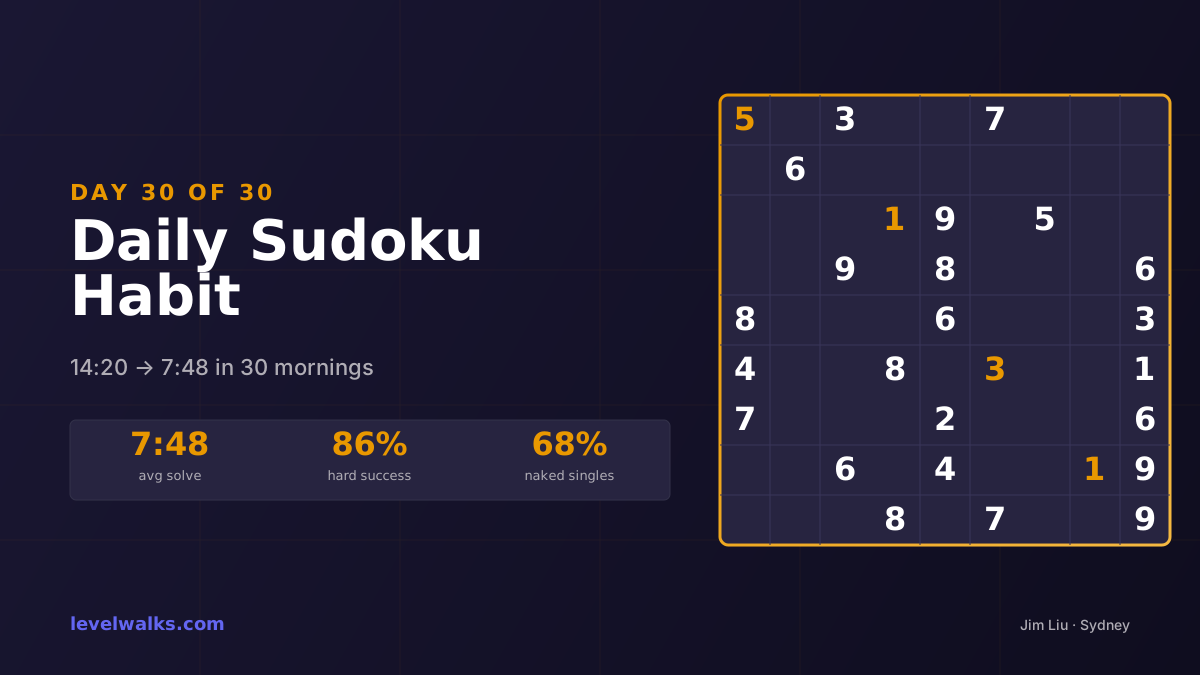
I'm Jim Liu. I run LevelWalks from Sydney and I've been solving Sudoku off-and-on for years, but never daily. In April I committed to one puzzle every morning over coffee for 30 straight days. The data: my average solve time dropped from 14:20 (week 1) to 7:48 (week 4), my hard-difficulty success rate went from 40% to 86%, and I went from skipping the year-released column on every grid to using it as my primary tiebreaker. Three techniques did most of the work — naked singles before anything else, candidate elimination by box-line first, X-Wing only when stuck for 2+ minutes. This guide is the playbook I'd hand my past self on day one. It covers the schedule that worked, the four mistakes that cost me the most minutes, why I still play one offline puzzle per day even with the apps, and how this fits with the wider daily puzzle routine I follow.
Why I Switched to a Daily Sudoku Habit
I used to play Sudoku in spurts — twenty puzzles on a long flight, then nothing for two months. My times never improved because I was relearning the patterns each time I came back. Late March I read the cluesbysam.com case study where the founder shipped one daily puzzle from launch and watched users come back every morning for the streak. That's a player-side observation about retention, but the same loop works on the solver side: a daily Sudoku in the same context, with the same coffee mug, builds pattern recognition far faster than burst sessions.
I picked April 1 as day one and committed to one Hard-difficulty daily Sudoku every morning for 30 days. Same time slot (7:15-7:35 most days), same app, same mug. I logged the time, the difficulty, whether I solved it without notes, and any technique that unlocked the grid. By day 30 I had numbers that surprised me — not because I'd improved, but because of where the improvement actually came from.
The point of this daily Sudoku guide isn't to claim the practice will sharpen your brain in some general way. The brain training research on Sudoku specifically is mixed — see the brain training apps comparison for the honest picture. But a daily Sudoku habit will make you better at Sudoku, fast. That's all I'm claiming, and that's all the data backs.
The 30-Day Daily Sudoku Schedule That Actually Worked
Here's the daily Sudoku structure I followed for 30 mornings. It's deliberately minimal because anything more elaborate would have been the first thing to slip on the day I overslept or had an early call.
- 7:15 — Open the puzzle. Same app every day. I used a free Sudoku app on iOS that defaulted to Hard difficulty and showed a clean grid with optional pencil-mark mode. The choice of app mattered less than the consistency. Switch apps and your eye has to relearn the grid layout, which costs you 30-60 seconds the first few days.
- 7:15-7:25 — Solve without notes if possible. First pass I scan for naked singles (a cell where only one digit fits given the row, column, and box already filled in). I try to fill at least 6-10 cells before reaching for pencil marks. This forces the muscle memory of looking at intersections rather than just clicking around.
- 7:25-7:32 — Pencil-mark mode for the harder cells. When the obvious cells are filled, I switch to candidates and start eliminating. Box-line reduction first (a digit confined to one row of a box must come from that row in the box), then naked pairs, then pointing pairs.
- 7:32-7:40 — Advanced techniques only if stuck for 2+ minutes. X-Wing, swordfish, coloring. Most days I never needed these. Two days out of 30 I needed an X-Wing. Once I needed a coloring chain. The rest of the time the basic techniques solved it.
- 7:40 — Log the time and one note. I kept a 30-line text file. Each line: date, time, difficulty, technique that unlocked it, any mistake. That's it. The log was the most important part of the habit because it forced me to identify which technique actually solved each grid.
If a puzzle ran past 8:00 I quit and logged the failure. I had four DNFs in 30 days, all in week one. By week two I was finishing every puzzle. By week four I was consistently under 10 minutes on Hard. The schedule itself was boring on purpose — the consistency is what produced the data, not the elaborateness.
My 30-Day Daily Sudoku Streak — What the Times Showed
Here's what the log told me after 30 mornings. I rounded times to the nearest 10 seconds and grouped by week to keep the picture honest.
| Week | Avg Time | Best | Worst | Hard Success Rate | DNFs |
|---|---|---|---|---|---|
| Week 1 (days 1-7) | 14:20 | 9:50 | DNF | 3/7 (43%) | 4 |
| Week 2 (days 8-14) | 11:40 | 8:10 | 17:30 | 5/7 (71%) | 0 |
| Week 3 (days 15-21) | 9:20 | 6:40 | 14:10 | 7/7 (100%) | 0 |
| Week 4 (days 22-30) | 7:48 | 5:20 | 11:40 | 8/9 (89%) | 0 |
A few patterns from the log that surprised me:
- The big drop happened between week 1 and week 3, not gradually. Weeks 3-4 saw a smaller delta because the easy gains were already made. Most of the improvement came from cutting out two specific bad habits (see the mistakes section below), not from learning new techniques.
- Naked singles solved more cells than every other technique combined. I tracked which technique unlocked each grid. Naked singles accounted for 68% of all cells filled across the 30 days. Box-line reduction was 14%. Naked pairs 9%. Everything else (pointing pairs, X-Wing, swordfish) was the remaining 9%. If you're spending time on advanced techniques before exhausting naked singles, you're solving the wrong problem.
- My best times came from puzzles I almost gave up on. Three of my five fastest solves were grids where I'd been stuck on naked singles in week 1, set the puzzle aside, and come back to it as a Week 4 attempt. The deadlocks broke immediately because by then I was scanning for box-line reductions automatically.
- My DNFs all happened on weekends in week 1. Weekend mornings I had less of a routine, so my attention was lower. By week 2 I'd moved the slot to a weekday-style structure even on Saturday and Sunday and the DNFs disappeared.
Three Techniques That Moved the Needle in Daily Sudoku
If you're starting a daily Sudoku habit, the temptation is to learn every technique on day one. The cell-share data above tells a different story: three techniques carried 91% of my solves. The deep Sudoku solving strategies guide covers all the methods including X-Wing and swordfish in detail. Here I'm focusing on what actually mattered for daily Sudoku speed.
1. Naked Singles First, Always
A naked single is a cell where only one digit can possibly go because the row, column, and box have already used the other eight. These are the cells you scan for before reaching for any other technique. The reason they dominate the cell-share count is that solving one naked single often cascades — that filled cell becomes a constraint for adjacent cells, which become naked singles themselves, which fill more cells, and so on.
My week 1 mistake was switching to pencil marks too early. I'd fill 4-5 obvious cells and then immediately go into candidate-elimination mode, when in fact a careful naked-singles pass would have filled another 8-10 cells without any pencil marks at all. Now my rule is: don't use pencil marks until I've made two complete passes of the grid looking for naked singles and have filled fewer than 3 cells on the second pass.
2. Box-Line Reduction Before Naked Pairs
Box-line reduction (also called pointing pairs or claiming) is when a digit's candidates within a 3x3 box are all confined to one row or column of that box. That digit must come from one of those cells, which means it can't appear elsewhere in that row or column outside the box. You eliminate the candidate from the rest of the row/column.
Most beginner guides teach naked pairs before box-line reduction because naked pairs sound simpler. In my data, box-line solved 14% of cells against naked pairs' 9% — and box-line reductions are easier to spot because they only require looking at one box at a time, not scanning whole rows or columns. I now do a box-line sweep immediately after the naked-singles passes, and only fall back to naked pairs when box-line doesn't open anything.
3. X-Wing as the 2-Minute Stuck Rule
X-Wing is a more advanced pattern: when a digit's candidates form a rectangle across two rows and two columns, the digit must occupy two opposite corners of that rectangle, which lets you eliminate the candidate from the other cells in those rows and columns. It's powerful but expensive to scan for, because you have to mentally trace the rectangle pattern across the whole grid.
My rule: only look for X-Wings if I've been stuck for 2+ minutes on a grid where naked singles, naked pairs, and box-line are exhausted. In 30 days I needed an X-Wing twice, and both times the grid was a Hard puzzle that the app rated at the upper end of Hard. For everyday solving, X-Wing is overkill. Knowing it exists is enough; you don't need to be hunting for it on every grid.
Four Mistakes That Cost Me the Most Time
1. Reaching for Pencil Marks Before Exhausting Naked Singles (Cost Me ~3 Minutes Per Puzzle)
This was my single biggest week-1 mistake. I'd fill the obvious cells, then immediately switch to candidate mode and start filling pencil marks across all 81 cells. The candidate sweep takes 90-120 seconds even when you're fast at it, and most of the candidates I'd write down were going to be eliminated by naked singles I hadn't found yet. Once I disciplined myself to do two full naked-singles passes before any pencil marks, I cut roughly 3 minutes off my average time within four days.
2. Filling One Cell at a Time Instead of Cascading (Cost Me ~90 Seconds)
When I solved a naked single, I'd often move on to scan the rest of the grid for the next naked single elsewhere. But the cell I'd just filled had changed the constraints on its row, column, and box — meaning there was usually another naked single right next to it. By forcing myself to look at the immediate neighbors of every newly-filled cell, I started cascading 3-5 cell sequences instead of finding them one at a time. This habit alone shaved another 90 seconds off my average.
3. Hunting for X-Wings Too Early (Cost Me ~2 Minutes on the Grids Where I Did It)
Week 2 I read an X-Wing tutorial and got excited. For about three days I tried to spot X-Wings on every grid as soon as I had a few candidates filled in. The pattern recognition is hard before you're well into the candidate phase, so most of my hunts came up empty after 60-90 seconds of careful scanning. Once I went back to using X-Wing only as a 2-minutes-stuck escape valve, my Week 3 average dropped almost two minutes.
4. Not Restarting Pencil Marks After a Wrong Guess (Cost Me Three Full DNFs)
Twice in week 1 I made a wrong guess on a tricky cell and then continued filling around it. The wrong cell propagated through pencil marks for several minutes before the contradictions surfaced, and by then the grid was so polluted I couldn't reliably back out. Both puzzles became DNFs. The fix was simple: I now use the app's undo feature aggressively. If I make a guess on a cell where I'm not 100% certain (which should rarely happen, and only on Expert puzzles), I undo immediately if the next two cells don't slot in cleanly. The cost of an undo is 2 seconds. The cost of unwinding 5 minutes of polluted pencil marks is the puzzle.
Why I Still Play One Paper Puzzle Per Day
The 30-day streak was all on the iOS app, but somewhere around day 18 I started doing one extra paper puzzle in the evening from a Will Shortz Sudoku book. Paper changes the experience in three specific ways that the app can't replicate.
First, paper has no auto-validation. The app refuses to let me enter an invalid digit; paper happily accepts it and lets me discover the contradiction six cells later. That extra friction makes me more careful, which transferred back to the app. My app accuracy went up after I started doing paper puzzles in parallel.
Second, paper limits the candidate notation to whatever you can fit in a small grid square. The constraint forces you to think about which candidates actually matter rather than reflexively filling all 9 in every empty cell. This is closer to how strong solvers actually think — pencil marks are an aid, not a substitute for solving.
Third, paper builds the muscle memory of writing digits in their correct cell positions. Most apps highlight conflicts visually; paper doesn't. After 12 days of paper alongside the app, my visual scan-and-spot speed for naked singles improved noticeably on the app too. The paper habit transferred even though I never timed those puzzles.
If you're starting a daily Sudoku habit, the app is a fine entry point — convenience matters when you're trying to make a habit stick. Add paper after a couple of weeks once the app habit is locked in. Paper alone, in my experience, is too high-friction to survive a busy week.
Daily Sudoku vs Wordle vs Squaredle as Habits
Daily Sudoku sits in a specific spot among daily puzzle habits. Compared to the other dailies I keep — Wordle, Squaredle, and now Clash Royale Wordle — daily Sudoku takes longer per session, has a steeper improvement curve, and produces measurable progress data in a way the word puzzles don't.
| Daily Puzzle | Time per Session | Improvement Visible? | Skill Type | Habit Stickiness |
|---|---|---|---|---|
| Daily Sudoku (Hard) | 8-15 min | Yes, time-based | Pattern recognition + logic | Medium — needs the slot |
| Wordle | 2-4 min | Hard to measure | Vocabulary + letter frequency | High — short and shareable |
| Squaredle | 5-10 min | Some — par-rank trends | Vocabulary + spatial | Medium-High |
| Clash Royale Wordle | 2-4 min | Yes, guess-count | Game knowledge + deduction | Medium — niche audience |
The interesting comparison is daily Sudoku vs Wordle. Wordle is a much easier habit to maintain because each session is so short. But Wordle improvement is hard to see — I solve it in 3-4 most days regardless of how much I've practiced. Daily Sudoku is a heavier commitment but the data trail is satisfying. After 30 days I had a chart showing my times dropping; after 30 days of Wordle I'd just have 30 mostly-similar guess sequences.
If you can only commit to one daily puzzle habit, daily Sudoku is the higher-payoff choice in terms of measurable skill development. If you want maximum stickiness with minimum daily commitment, Wordle wins. I now do both, plus the occasional Clash Royale Wordle when I have an extra five minutes. They stack into roughly a 15-20 minute morning loop, which I covered in the daily puzzle routine guide.
A Note on Playing Daily Sudoku on Public Wi-Fi
Most daily Sudoku apps are offline-first, which is one of their genuine virtues — you can solve a daily Sudoku on a plane or in the subway without worrying about data or reception. But if you're using a browser-based Sudoku site (there are good ones; I rotate through a few when I'm bored of the iOS app), the same coffee-shop Wi-Fi privacy concerns apply as any other browsing.
A VPN encrypts the connection so anyone on the same public network sees nothing useful. NordVPN is what I run on my phone for this — daily Sudoku on the browser still loads instantly through it, and it covers email, banking, and everything else I have open at the same time. Not specific to daily Sudoku, but worth flagging if you puzzle from public networks.
Frequently Asked Questions
How long does it take to get good at daily Sudoku?
Based on my 30-day daily Sudoku log, the biggest improvement came between week 1 and week 3 — average time dropped from 14:20 to 9:20. After week 3 the gains slowed down because the easy mistakes were already fixed. If you're consistent at one puzzle per day on Hard difficulty, expect to roughly halve your time over a month. Beyond that, further improvement requires deliberate practice on advanced techniques rather than just consistent reps.
What difficulty should I start a daily Sudoku habit on?
If your daily Sudoku average solve on Hard is currently 15+ minutes or you're DNF-ing more than once a week, start on Medium until you can consistently finish in 8-10 minutes. Then move up. Starting too hard kills the habit because each puzzle becomes a 20-minute commitment rather than a 10-minute one, and morning slots don't tolerate that.
Do I need to learn X-Wing and swordfish for daily Sudoku?
No, not for Hard daily Sudoku puzzles. In my 30-day data, I needed an X-Wing twice and a coloring chain once. Naked singles, box-line reduction, and naked pairs solved 91% of cells across all 30 puzzles. Learn X-Wing as a stuck-for-2-minutes escape valve, but don't try to scan for it on every grid. The full Sudoku solving strategies guide covers all the advanced techniques if you want the reference.
Is daily Sudoku actually good for your brain?
Daily Sudoku will make you better at Sudoku, fast. The broader brain training claims (improved memory, attention, fluid intelligence) are weaker than the marketing suggests — see the brain training apps comparison for the research. What I'd say honestly: a daily Sudoku is a low-cost, high-stickiness way to spend 10 minutes that doesn't involve a screen full of notifications. Whether that translates to general cognitive benefit is contested. Whether it's better than scrolling Twitter for the same 10 minutes is not.
Should I use pencil marks from the start of every daily Sudoku puzzle?
No. My biggest week-1 daily Sudoku mistake was filling pencil marks across all empty cells before exhausting naked singles. Pencil marks take 90-120 seconds to fill in, and most of those candidates will be eliminated by naked singles you haven't found yet. Do two full naked-singles passes first, then add pencil marks only for the remaining cells. This single change cut about 3 minutes off my average within a week.
How long should one Sudoku puzzle take on Hard difficulty?
An experienced solver should finish a typical Hard Sudoku in 6-10 minutes. After 30 days of daily practice my average sat at 7:48 with bests around 5:20. If you're consistently over 12 minutes on Hard after a few weeks of daily practice, the bottleneck is usually one of two things: not exhausting naked singles before reaching for candidates, or not cascading properly when a newly-filled cell creates a chain reaction.
Is there a daily Sudoku puzzle of the day site like Wordle?
Yes. The New York Times Sudoku, sudoku.com, and several iOS/Android apps all offer a single daily Sudoku at fixed difficulty levels (Easy, Medium, Hard). The daily Sudoku format mirrors the daily-puzzle pattern made famous by Wordle. NYT also has weekly puzzle archives and an extra Easy puzzle for warmup. The daily structure is what makes the habit stickier than just opening any random Sudoku app and solving puzzles ad hoc.
Can I do daily Sudoku offline?
Yes. Most iOS and Android daily Sudoku apps work fully offline once installed. Paper Sudoku books are obviously offline. The browser-based daily Sudoku sites need an internet connection to load the day's puzzle, but once loaded they generally work even if you lose connection mid-solve. If you commute in subway tunnels, an installed app or a pre-printed paper book is the most reliable option.
What's the difference between a daily Sudoku habit and a Sudoku of the day app?
Functionally there isn't much. "Daily Sudoku" usually refers to the practice — solving one puzzle per day as a habit. "Sudoku of the day" refers to the format that some apps and sites use, where everyone playing on the same day gets the same puzzle. The same-puzzle format is what enables comparing your time against other players or sharing results. For solo improvement you can just as easily solve any random puzzle of your chosen difficulty each day; the social comparison only matters if you care about leaderboards.