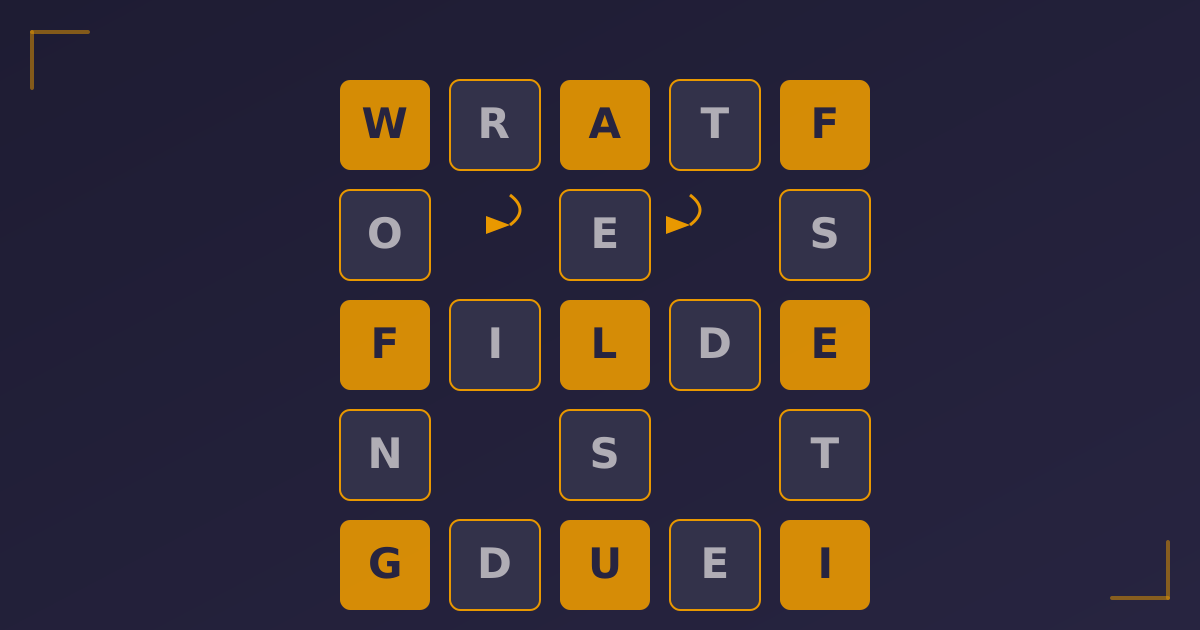
Waffle is a daily word puzzle played on a waffle-shaped grid — 5 rows and 5 columns with the corners removed, forming a cross-hatched pattern where 6 words intersect. You get 15 swaps to rearrange scrambled letters into the correct positions. Green letters are already placed correctly, yellow means right letter but wrong spot, and gray letters aren't in that word at all. The key strategies: lock in corner letters first (they belong to two words simultaneously), map vowels early, and work from confirmed green tiles outward. Over 1,500 daily puzzles have been published so far. This guide walks through the mechanics, swap-efficient solving methods, common traps, and how Waffle compares to Wordle, NYT Connections, and Squaredle.
What Is Waffle?
Waffle is a free daily word puzzle created by James Robinson. The game gives you a waffle-shaped grid. Imagine a 5x5 square with the four corner cells removed, filled with scrambled letters. Your job is to swap letters around until six five-letter words read correctly: three horizontal and three vertical, all intersecting at shared positions. You get exactly 15 swaps to finish the puzzle.
The game launched in early 2022 and has run continuously since, passing 1,500 daily episodes. One puzzle per day, same grid for everyone. Unlike Wordle where you guess blind, Waffle shows you all the letters upfront. The challenge is figuring out where each one belongs. The color coding (green, yellow, gray) updates after every swap, giving you real-time feedback on your progress.
I started playing Waffle about a year ago after Wordle stopped scratching the itch. What hooked me was the spatial reasoning element. It's not just vocabulary knowledge, it's rearranging a physical grid, almost like a sliding tile puzzle crossed with a crossword. The 15-swap limit means you can't brute-force your way through. Every swap has to count.
How the Waffle Grid Works
The grid shape is distinctive and understanding its geometry matters for solving efficiently:
- 21 letter tiles: The waffle grid has 21 cells arranged in a cross-hatch pattern. Three horizontal rows of five letters each, three vertical columns of five letters each, sharing 9 intersection points.
- Intersection tiles: 9 of the 21 tiles sit at word intersections. They belong to both a horizontal and a vertical word simultaneously. Getting these right is critical because one correct placement fixes two words at once.
- Color feedback: Green means the letter is in the correct position. Yellow means the letter belongs in that word but is in the wrong spot. Gray means the letter doesn't belong in that word at all (but it belongs somewhere else on the grid).
- Swap mechanic: You drag one letter onto another to swap their positions. Both letters move. You can swap any two letters on the grid, not just adjacent ones.
- 15 swap budget: You start with 15 swaps. A perfect solve (finishing with 10+ swaps remaining) earns five stars. Using all 15 swaps exactly earns one star. Running out of swaps before completing the grid means a loss.
The intersection points are what make Waffle interesting. In a regular word puzzle, each letter only needs to satisfy one word. Here, the 9 intersection letters must work in two directions simultaneously. This constraint actually helps you, once you figure out one word, its intersection letters narrow down the crossing words considerably.
Core Strategies for Solving Waffle
1. Corners First. Always
The four corner positions of the waffle grid (positions at the ends of horizontal words that also begin or end vertical words) are the most constrained spots. Each corner letter must be the first or last letter of two different words. That double constraint means fewer letters can possibly fit there. Start every puzzle by figuring out which letters belong in the corners.
Practically, look at which letters are already green in the corners. If a corner is yellow, it's in the right word but wrong position, check if it belongs in the opposite corner of that same word. If it's gray in that word, it must belong to a different word entirely. Resolving corners first typically uses 2-4 swaps and locks down the framework for everything else.
2. Map Your Vowels
Count the vowels on the grid and note which words they could belong to. Five-letter English words follow predictable vowel patterns. Most have one or two vowels, occasionally three. If you see three A's on the grid, you know roughly how they distribute across six words. Vowels at intersection points are especially telling because they narrow options in both directions.
A useful trick I picked up after about a hundred puzzles: identify any word that has zero vowels currently showing in yellow or green. That word needs vowels swapped in from elsewhere on the grid. Finding which vowels belong where is often the key that unlocks the rest of the puzzle.
3. Green Tiles Are Your Anchors
Every green tile is a confirmed letter in its final position. Build outward from green tiles. If a horizontal word has its first and third letters green (say, S_A_E), you're looking for five-letter words matching S?A?E, SHADE, SHAKE, SNARE, SPACE, STARE, STATE. Cross-reference with the vertical words at positions 2 and 4 to narrow it further. Green tiles compound. Each new one you create makes the remaining words easier to deduce.
4. Use Yellow Letters as Clues, Not Guesses
A yellow letter tells you two things: this letter belongs in this word, and it's not in this position. On a five-letter word with two green letters and one yellow, you now know three of the five letters and the yellow one's position is constrained to just two remaining slots. That's usually enough to identify the word outright, which means you can place the yellow letter with confidence rather than burning a swap on a guess.
This connects to a broader principle about how word puzzles train your brain. The skill isn't vocabulary memorization, it's deductive reasoning under constraints. Waffle trains this more directly than most word games because every swap gives you immediate visual feedback.
5. Look for Mutual Swaps
The most efficient move in Waffle is a mutual swap. Where two letters are each sitting in the other's correct position. Swapping them puts both letters home in a single move. Before making any swap, scan the grid to see if the letter you want to move is currently occupying the target position of another displaced letter. Prioritizing mutual swaps can save you 3-5 moves per puzzle, which is the difference between a five-star and a two-star finish.
Advanced Techniques
Chain Solving
Once you get comfortable with the basics, start thinking in chains. A chain is a sequence of swaps where each move creates a new green tile that reveals information for the next move. For example: placing the correct letter in a corner turns it green, which confirms the intersection letter for the crossing word, which narrows that word to one possibility, which tells you where another displaced letter belongs. Experienced players can chain 4-5 deductions from a single swap.
The mental model is similar to Sudoku, you're not solving cells in isolation, you're propagating constraints across the grid. If you enjoy that kind of logic cascading, Waffle will click for you. If you prefer the more vocabulary-heavy challenge of grid-based word finding, Squaredle might be more your speed.
The Gray Letter Elimination Method
Gray letters are underrated as a solving tool. A gray letter in word A means it doesn't belong anywhere in word A. But it must belong somewhere on the grid. Cross-reference all the gray letters across all six words. If a letter is gray in five of the six words, it must belong to the sixth. This process of elimination frequently identifies exactly where stubborn letters go without any guesswork.
Playing for Stars
The star system rewards efficiency. Five stars requires finishing with 10+ remaining swaps, meaning you solved the puzzle in 5 or fewer moves. This is achievable on maybe 30-40% of puzzles if you're disciplined about mutual swaps and chain solving. The key habit: never swap until you're certain both letters are going to their final positions. Speculative swaps — "let me try this and see what turns green". Are star killers. Treat every swap as a commitment, not an experiment.
Research into the cognitive science behind word games suggests that this kind of deliberate, constraint-based problem solving builds working memory capacity over time. Waffle's swap limit forces exactly this kind of disciplined thinking.
Common Mistakes and Traps
Swapping Too Early
The most common mistake, especially for players coming from Wordle where guessing is the core mechanic. In Waffle, information is free (the color coding updates constantly), but swaps are expensive. Spend 60-90 seconds analyzing the board before making your first move. Identify at least 2-3 certain swaps before touching anything. The players who consistently get five stars are the ones who solve 70% of the puzzle mentally before their first swap.
Ignoring Intersection Constraints
Solving a horizontal word in isolation without checking whether the intersection letters also work vertically. This leads to situations where you've used 3 swaps to complete one word, only to realize an intersection letter breaks the crossing word. Always verify both directions before committing a swap at an intersection point.
Getting Tunnel Vision on One Word
If you can't figure out one word, move to another. Waffle's grid means that solving surrounding words will reveal letters in the stubborn word through intersections. I've had puzzles where I stared at a word for two minutes with no progress, then solved the two crossing words and the mystery word filled itself in automatically.
The Ambiguous Valid Swap Trap
Here's an honest frustration: sometimes two different five-letter words fit the same slot with the available letters, and both are common English words. You have S_A_E and both STARE and STAVE work. The only way to resolve this is through the intersection constraints. Whichever crossing word needs an R vs a V in that position determines the answer. But if you don't check the crossing word first, you might waste a swap on the wrong one. This ambiguity is a real design limitation that shows up maybe once every 8-10 puzzles.
Waffle vs Wordle vs NYT Connections vs Squaredle
| Feature | Waffle | Wordle | NYT Connections | Squaredle |
|---|---|---|---|---|
| Objective | Swap letters to form 6 intersecting words | Guess one 5-letter word in 6 tries | Group 16 words into 4 categories | Trace paths to find all hidden words in a grid |
| All Letters Visible? | Yes. Every letter is on the board | No. You guess blind | Yes, all words shown | Yes. Full grid visible |
| Time to Complete | 3-8 minutes | 2-5 minutes | 5-10 minutes | 10-30 minutes |
| Skill Type | Spatial reasoning + deduction + vocabulary | Deduction + letter frequency | Lateral thinking + categorization | Vocabulary + spatial path-tracing |
| Move Limit | 15 swaps | 6 guesses | 4 mistakes | Unlimited |
| Grid/Spatial Element | Yes, waffle-shaped crossword grid | No | No | Yes. Adjacency tracing |
| Difficulty Curve | Consistent, varies by word obscurity | Random. Depends on the word | Escalating. Purple category is always hard | Grows with grid size (weekends harder) |
| Star/Score System | 1-5 stars based on swaps remaining | Share grid (1/6 to 6/6) | Mistakes count (0-4) | Word count percentage + bonus words |
Waffle occupies an unusual niche. It's the most crossword-like of the daily word puzzles, but the swap mechanic makes it feel more like a spatial logic game than a vocabulary test. If you enjoy Wordle's daily ritual but wish it lasted longer and demanded more strategic thinking, Waffle fills that gap without the 30-minute commitment that Squaredle sometimes requires.
The key distinction is information availability. Wordle hides everything and asks you to discover. Waffle reveals everything and asks you to organize. That's a fundamentally different cognitive challenge, and players who find Wordle frustrating because of the guessing element often prefer Waffle's deterministic nature, every puzzle is solvable with pure logic if you read the colors correctly.
If you're exploring the daily word puzzle space more broadly, the Contexto strategy guide covers another interesting variant that tests semantic proximity rather than letter arrangement.
Staying Safe While Gaming Online
Brief note for players who access Waffle or other browser-based puzzles on public networks: your browsing data is visible to others on shared Wi-Fi. This matters less for a word puzzle by itself, but most people play during a browsing session that also involves email, banking, or social media in other tabs.
A VPN encrypts everything so public network snooping becomes irrelevant. NordVPN handles this without noticeable speed impact on browser-based games. Not a Waffle requirement, but worth having if you puzzle on coffee shop Wi-Fi.
Frequently Asked Questions
How many words does a Waffle puzzle contain?
Every standard Waffle puzzle contains exactly 6 five-letter words. 3 horizontal and 3 vertical. They intersect at 9 shared letter positions, forming the waffle grid shape. Some special event puzzles (like Deluxe Waffle) use a larger grid with more words, but the daily puzzle is always 6 words.
Is Waffle free to play?
Yes. The daily Waffle puzzle is completely free at wafflegame.net. There are no premium tiers or paywalled features for the standard daily game. A Deluxe variant (larger grid) and archived puzzles may require a small payment, but the core daily experience costs nothing.
What does it mean to get 5 stars in Waffle?
Five stars means you completed the puzzle with 10 or more swaps remaining — in other words, you solved it in 5 or fewer moves. Each unused swap beyond the minimum earns you credit toward stars. It's the efficiency metric, not just completion. Consistently hitting five stars requires planning all your swaps mentally before executing any of them.
Can I play previous Waffle puzzles?
The game archives past puzzles. You can access older daily puzzles through the archive feature on the website. This is useful for practice. If you're trying to improve your star average, replaying archived puzzles lets you experiment with different solving orders without affecting your daily streak.
Is Waffle harder than Wordle?
They test different skills, so direct comparison is tricky. Waffle shows you all the letters upfront, which eliminates the blind guessing frustration of Wordle. But Waffle demands spatial reasoning and multi-word deduction that Wordle doesn't require. Most players who try both find Waffle takes about twice as long per session and requires more strategic planning, while Wordle is faster but involves more luck. Neither is objectively harder, they exercise different mental muscles.
What happens if I run out of swaps?
If you use all 15 swaps without completing the puzzle, the game ends and shows you the solution. You can still see which words were correct and learn from the ones you missed. Your streak doesn't break from a failed puzzle. Only from missing a day entirely. Running out of swaps happens occasionally even to experienced players, usually when the puzzle contains an uncommon word that creates misleading swap paths.
How is Waffle different from a crossword?
In a crossword, you fill in empty squares from clues. In Waffle, all the letters are already on the board. Just in the wrong positions. There are no external clues. The color feedback (green, yellow, gray) replaces traditional crossword clues with positional information. The swap limit adds a resource management layer that crosswords don't have. It's closer to an anagram-crossword hybrid with a spatial puzzle element. For more on how different puzzle formats compare for brain training, check the Brain Test guide.