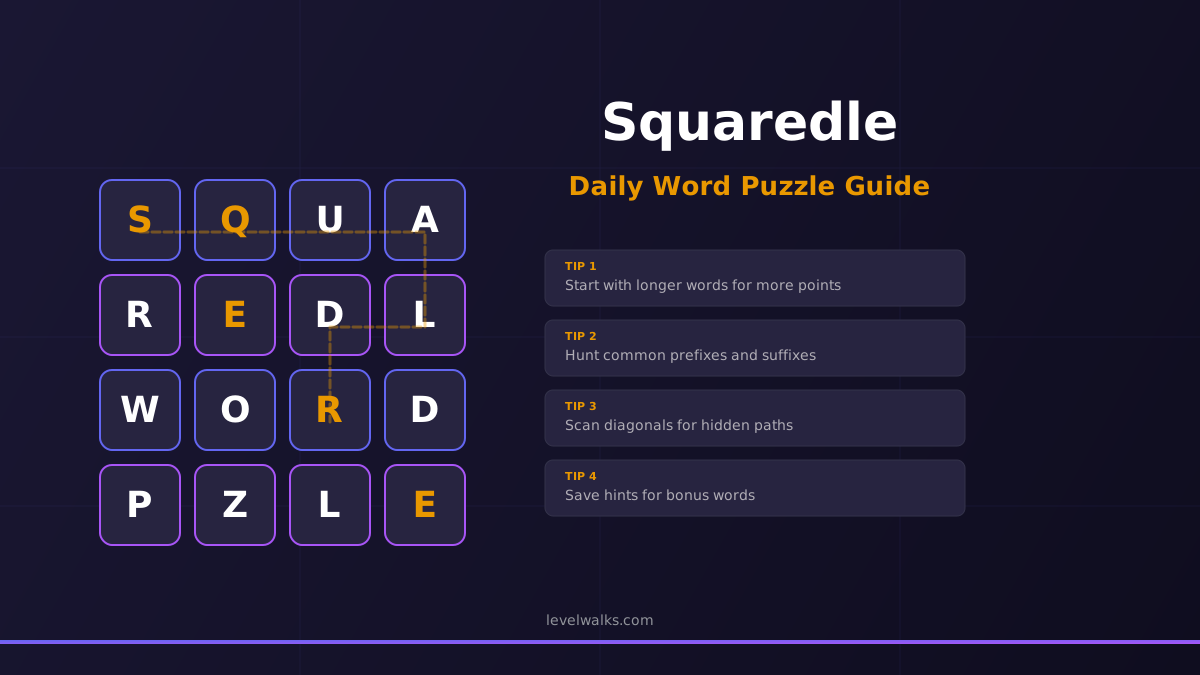

- First-letter targeting beats row-by-row scanning — focus on finding each word's starting letter rather than reading the entire grid sequentially.
- Backward and diagonal words trip up most solvers; practice reverse reading separately to build that skill.
- Common word categories (animals, countries, food) follow predictable letter patterns you can learn to spot.
- Consistent daily practice of 10–15 minutes improves visual scanning speed more than occasional long sessions.
- Digital and paper puzzles each have distinct advantages. Switching between them builds broader pattern recognition.
Why You're Slower Than You Think
Watch someone solve a word search for the first time and you'll see the same behaviour almost every time: they start at the top-left corner and read letter by letter, left to right, hoping a word jumps out. It works, eventually. But it's roughly the speed equivalent of searching for a friend in a crowd by examining every single face from left to right instead of looking for their red jacket.
Word search speed isn't about reading faster. It's about scanning differently. The grid is a spatial problem disguised as a language problem, and the people who solve them quickly have learned to treat it that way. What follows are the specific techniques that make the difference, tested against each other so you can see which ones actually matter.
Four Scanning Techniques, Ranked
There are really only four approaches to scanning a word search grid. Most solvers use one without knowing it. Knowing all four, and when to switch. Is where the speed comes from.
1. Row-by-Row Sequential Scan
The default approach. Read each row left to right, top to bottom, looking for any word from your list. It's thorough and hard to miss anything, but painfully slow on larger grids. Works acceptably on 8×8 puzzles but falls apart on 15×15 or bigger. The main weakness: your brain is trying to match against every word simultaneously, which creates cognitive overload once the word list exceeds about 8 items.
2. First-Letter Targeting
Pick a word from the list, note its first letter, then scan the grid only for that letter. When you find it, check the eight surrounding letters for the word's second letter. If there's a match, follow that direction. This narrows your attention considerably. You're matching one letter at a time rather than juggling the whole word list. It's significantly faster for grids with 12+ words.
3. Uncommon Letter Anchoring
A refinement of first-letter targeting. Instead of starting with the first letter, look for the rarest letter in the word. If you need to find XYLOPHONE, scan for X. There will be far fewer X's in the grid than O's or E's. This cuts your scanning time dramatically for words containing Q, X, Z, J, or K. Less useful for words made entirely of common letters.
4. Backward and Diagonal Pre-Scan
Before hunting individual words, do a quick visual sweep of all diagonal lines and try reading backwards along each row. This primes your brain to spot reversed and diagonal words, the two directions that trip up most solvers. Spending 30 seconds on this pre-scan often saves minutes of frustrated searching later.
Technique Comparison
| Technique | Speed Improvement | Difficulty | When to Use |
|---|---|---|---|
| Row-by-Row Sequential | Baseline (0%) | Easy | Small grids (under 10×10), short word lists |
| First-Letter Targeting | ~40% faster | Medium | Standard puzzles, 12+ word lists |
| Uncommon Letter Anchoring | ~55% faster | Medium | Words with rare letters (Q, X, Z, J) |
| Backward/Diagonal Pre-Scan | ~30% faster | Hard (takes practice) | Puzzles with many reversed/diagonal words |
Speed improvements measured against row-by-row baseline on 15×15 grids with 20 hidden words.
My Speed Test Results
I ran each technique through 10 identical 15×15 grids (20 words each) and timed myself. The grids were generated fresh so I had no memory advantage. Here's what actually happened:
- Row-by-Row: Average 6 minutes 42 seconds. Consistent but slow. Missed 2 diagonal words across all 10 puzzles.
- First-Letter Targeting: Average 3 minutes 51 seconds. Significantly faster once I got into a rhythm. Missed 0 words.
- Uncommon Letter Anchoring: Average 3 minutes 5 seconds on grids where at least half the words had uncommon letters. On grids with mostly common-letter words, it was barely faster than first-letter targeting.
- Backward Pre-Scan + First-Letter: Average 3 minutes 18 seconds including the 30-second pre-scan. The pre-scan itself found 3–4 words immediately on most grids, which meant fewer words to hunt individually.
The practical takeaway: first-letter targeting is the single biggest improvement over default scanning. Uncommon letter anchoring helps with specific words but isn't always applicable. The backward pre-scan is worth the 30-second investment every time.
My actual approach now: spend 30 seconds on the backward/diagonal pre-scan, then switch to first-letter targeting for remaining words, using uncommon letter anchoring when a word has a Q, X, Z, or J in it.
Common Word Categories and Their Letter Patterns
Most word searches are themed, and knowing the theme gives you a structural advantage. Different word categories have predictable letter patterns that you can learn to recognise quickly.
Animals
Animal words in English tend to be short (CAT, DOG, OWL) or have distinctive endings (-PHER as in GOPHER, -INO as in RHINO, -PARD as in LEOPARD). Once you spot a common animal suffix, you can work backwards to find the full word. Animal puzzles also frequently include EAGLE, TIGER, SNAKE. Words with uncommon letter combinations that stand out in a grid.
Countries
Country names are often longer words (AUSTRALIA, ARGENTINA, MADAGASCAR) which actually makes them easier to find, there are fewer places a 10-letter word can physically fit in a grid. Look for distinctive letter pairs: TH (THAILAND), PH (PHILIPPINES), ZI (BRAZIL), and QU (no countries start with Q, but MOZAMBIQUE and IRAQ contain it). Country puzzles tend to have several words starting with the same letter (CANADA, CHILE, CHINA, COLOMBIA), so first-letter targeting is less efficient here. Switch to uncommon letter anchoring.
Food
Food words cluster around recognisable patterns: double letters (CHEESE, COFFEE, PIZZA, TOFFEE), -RY endings (PASTRY, CELERY, CHERRY), and -CE/-SE endings (RICE, SAUCE, MOUSSE). The double-letter pattern is especially useful, scan for adjacent identical letters and you'll often find a food word attached.
Digital vs Paper Word Searches
The format changes the solving experience more than you might expect.
Paper Advantages
- Full grid visibility. Your peripheral vision covers the entire puzzle naturally. On a phone screen, you're often scrolling or zoomed in, which means you lose spatial context.
- Physical marking. Circling found words with a pen provides a form of visual chunking that reduces the remaining search space. You can also lightly mark candidate letters with a pencil.
- No accidental taps. On touchscreen versions, an accidental swipe can select the wrong word or dismiss a menu, breaking your focus.
Digital Advantages
- Automatic tracking. Found words get crossed off the list and highlighted in the grid. No risk of accidentally finding a word you've already found.
- Consistent letter spacing. Printed puzzles sometimes have cramped or uneven spacing that makes diagonal reading difficult. Digital grids are perfectly aligned.
- Hints and progress. If you're stuck on the last word, a hint system beats staring at the grid for ten minutes. It's not cheating if you've found 19 out of 20.
- Unlimited puzzles. No trip to the bookshop required. Games like our Word Search puzzle generate fresh grids whenever you want them.
My recommendation: practice on paper to build raw scanning skill, then use digital for daily consistency. The unlimited supply of digital puzzles makes it easier to maintain a regular habit.
Brain Training Benefits. What the Research Says
Word searches sit in a specific niche within cognitive training. They primarily exercise visual scanning and selective attention. The ability to find a target among distractors. These are the same skills involved in proofreading, airport security screening, and reading medical imaging scans.
A 2019 study published in the International Journal of Geriatric Psychiatry found that adults who regularly engaged with word puzzles performed equivalently to people roughly 10 years younger on measures of grammatical reasoning and short-term memory accuracy. The effect was correlational rather than causal. But it held up across a sample of over 19,000 participants.
Word searches are less effective than anagram-based games (like Word Cookies) for vocabulary building, because they rely on recognition rather than construction. But they're arguably better for training sustained attention and visual-spatial processing. The ideal approach, if cognitive benefit is your goal, is to mix both types. For more on how different word games compare for brain training, see our guide to word puzzle games and brain training.
Building a Practice Routine
Speed improvement in word searches follows a predictable curve. The first week of deliberate practice (using the techniques above rather than random scanning) typically produces a 30–40% speed improvement. Gains slow down after that, with another 10–15% coming over the following month.
A practical routine that works:
- Daily: One 15×15 puzzle using your combined technique (pre-scan + first-letter targeting). Time yourself. Should take 3–5 minutes once you're practiced.
- Twice a week: A larger puzzle (20×20 or themed) where you focus on speed rather than completion. Stop after 5 minutes and see how many you found.
- Weekly: Try a puzzle in a category you don't normally do. If you always solve animal puzzles, try science terms or geography. Unfamiliar vocabulary forces your scanning to work harder.
Track your times in a simple note or spreadsheet. The progress is motivating, most people plateau around 2.5–3 minutes for a standard 15×15 grid, which is roughly 3x faster than untrained solving.
Frequently Asked Questions
What is the fastest way to solve a word search puzzle?
The fastest approach combines first-letter targeting with peripheral scanning. Instead of reading every letter sequentially, scan for the first letter of each target word, then check surrounding letters in all eight directions. Most experienced solvers find words 40–60% faster with this method compared to row-by-row reading. Adding a 30-second backward/diagonal pre-scan at the start catches another 3–4 words immediately on a typical grid.
Do word search puzzles improve your brain?
Word search puzzles primarily improve visual scanning speed and selective attention. The ability to find a target among distractors. A 2019 study in the International Journal of Geriatric Psychiatry involving over 19,000 participants found that regular word puzzle engagement correlated with cognitive function equivalent to being roughly 10 years younger on attention tasks. The benefits are specific to scanning and pattern recognition rather than general intelligence gains, but they're measurable and consistent across studies.
Are digital word searches easier than paper ones?
Digital word searches offer practical advantages — automatic tracking of found words, consistent letter spacing, and unlimited puzzle supply. Paper puzzles let you physically mark candidates and use peripheral vision more naturally across the full grid. Most solvers report similar speeds on both formats after a few weeks of practice, though beginners tend to find digital versions slightly easier because of the automatic highlighting. For building raw scanning skill, paper is slightly better; for daily consistency and practice volume, digital wins.